
If English wine producers are feeling really good about the way, things are going, as we move on to 2026, who am I to blame them!
In what is still a marginal climate, England has truly emerged as a wine region to be reckoned with an one delivering very good vintages – maybe not yet quite ‘like pearls on a string’, but with increasing frequency, and the number of producers rightfully claiming their part of the spotlight continues to grow.
A brief look at the last decade or so – and let us just take the horrendous vintage 2012 as maybe a modern-time low – vintages 2013 through 2022 all being good or better with 2018 being truly outstanding with large quantities of wine of very high quality and 2020 just a notch down from it. Just talk to different to producers and hear, how they laud different vintages for producing their best wine ever, and this September I did talk to several English producers and tasted their portfolios, as England put on quite a show at their Embassy in Copenhagen.
Such developments obviously attract new players to the ball-park and Wine GB’s Trade Report 2025 reports of 74 new vineyards, bringing the total to 1,104 and 25 newly registered wineries from the current total of 248. The total number of hectares under vines is a massive 4,841 ha, which is a growth of a whopping 510% since 2005 and a number expected to continue to grow over the next few years.
Some prognoses even expect total plantings to climb to more than 7,200 ha by 2032!
With such numbers of hectares come big quantities of wines, currently with quite a hefty price tag attached to them and I have earlier raised the question, if an English domestic market fuelled by nearby London and a growth in incoming wine tourism could match the rapidly increasing output from the wineries.
2023 was an absolute bumper vintage, up 50% from 2018 and one way to utilize such quantities to future benefits could be to cut down on prices for 2023s, baring the absolute top wines, to get more people to taste English wines at more affordable prices and thus raising awareness of it as a brand.
A webinar with Sam Linter, formerly of Bolney Wine Estate and currently Director of Wine at Plumpton College, casted light on challenges in English wine production such as a shortage of tanking facilities for the biggest vintages, quite the paradox as bigger yields (of quality fruit) in the vineyards is suggested by Linter to be a focal point in making wine production more financially viable in England.
Quantities remain a cause for concern, but it seems, they might get a substantially lesser burden to carry due to successes on the export markets.
Exports are booming, growing from 4% of the production in 2021 to an impressive 9% in 2024! And one particular market is currently very important to English wine producers: Norway. Norway is responsible for no less than 55% of the wines exported from England according to Wine GB with the Nordics holding four of the top-6 spots. Only Japan and USA have managed to squeeze in in second and third position respectively.
90% of these 55% being exported is sparkling wine, which really goes to prove, that English sparkling wine has established itself as a world class product – and the best of the pack easily fall into the category of ‘luxury item’.
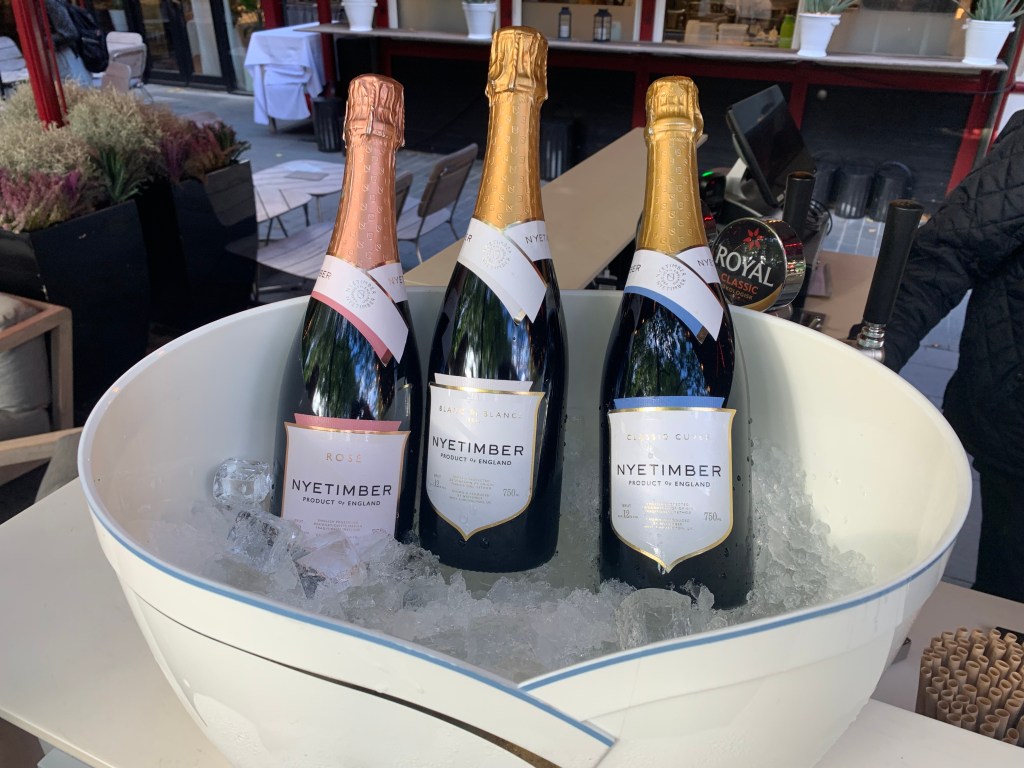
Nyetimber
No English producer fits the ‘luxury item’ better than Nyetimber in West Chiltington, Sussex. Nyetimber got its name from a mentioning of ‘Nitimbreha’ back in 1086 and England’s first ever Prestige Cuvée was actually named ‘1086 by Nyetimber’ to commemorate this.
Nyetimber has been around since the 1980s, but especially under the current owner, Eric Heerema, who took over in 2006, Nyetimber has cemented its status as a sparkling wine icon in England and one to truly rival the mighty Champagne and Heerema spares little in his efforts.
Not that his ambition was ever to mirror Champagne, nor does the profile actually mirror Champagne. Due to climatic influence, the fruit will always be more at the front in Nyetimber’s wines, compared to its French counterparts.
Nyetimber are being recognized for the very high quality of its wines and Heerema’s signing of Head Winemaker Cherie Spriggs in 2007 turned out to be nothing less than a steal, as Spriggs has gone from success to success at Nyetimber.
A remarkable milestone was achieved, when in 2018 Spriggs became the first female let alone the first outside of Champagne to win Sparkling Winemaker of the Year at International Wine Challenge (IWC) and even more impressively, Spriggs took home the title once more at IWC 2025 and at the same event won the Champion Sparkling Wine trophy for Nyetimber Blanc de Blancs 2016 from a magnum bottle. This marked the first time ever for this highly prestigious award to be awarded to a producer outside of Champagne!
2025 had Nyetimber going from success to success, as 1086 by Nyetimber 2010 went on to beat 25 wines from across the world, including Dom Pérignon 2013, Cristal and Krug 72th Edition at London Wine Fair. From the 16 judges, MWs, MSs and expert sparkling wine writers, one judge even scored the wine a perfect 100/100 points.
Nyetimber@Odette
The ever-increasing recognition of Nyetimber across the world brought about a tête-a-tête with Singapore Michelin *** Odette – right in in the middle of fine dining hub Copenhagen, whose ‘Michelin star restaurants to population ratio’ only few cities, if any, in the world can match.
Odette is French cuisine drawing intensely on Japanese inspiration in the courses. Matching traditional method sparkling wines with Japanese or Japanese fusion cuisine is really intriguing and highly rewarding as an early autumn dinner at Odette’s pop-up at Tivoli in Copenhagen illustrated.
A highly impressive lineup of top bottles from Nyetimber were presented:
Classic Cuvée 2010 (from magnum), Blanc de Blancs 2016, 1086 by Nyetimber 2013, 1086 by Nyetimber Rosé 2013, Tillington Single Vineyard 2016 and the recent addition of Cuvée Cherie.
A tour de force of some of the very best sparkling wines to have come out of England and the evening spoke volumes of the quality of the wines from Spriggs and just how well they pair with the exquisite cuisine of Odette’s Executive Chef, Levin Lau.
Nyetimber have long felt like missing a sweeter-style sparkling to pair with sweeter desserts and Spriggs has provided the answer: Cuvée Cherie, a demi-sec style sparkling – England’s first of its kind – made solely from Chardonnay grapes from vineyards in West Sussex and Hampshire.
38 grams of residual sugar and 8,5 grams of acid per liter make for a beautiful balance between sweetness and crisp acidity, and in combination with aromas of pure lemon, mineral, honey and a hint of tangerine, Cuvée Cherie meets the needs.
Wiston Estate, producing wines in West Sussex, was unknown to me, even if the Danish importer is based a mere 5 km away from me.
Wiston Estates dates back to 2006 ‘with a purpose of creating a rural meeting place for people, nature and entreprise to coexist and flourish’, as they put it, but the Gorings have been around since 1743(!). But grapes have actually been grown on the chalky sloapes since the Roman Empire.
Currently, the estate has 10 ha planted with Pinot Noir, Meunier and Chardonnay. Generally, their wines get around 3-4 years of lees contact and some 7-8 grams of dosage, alas quite the Champenoise treatment.
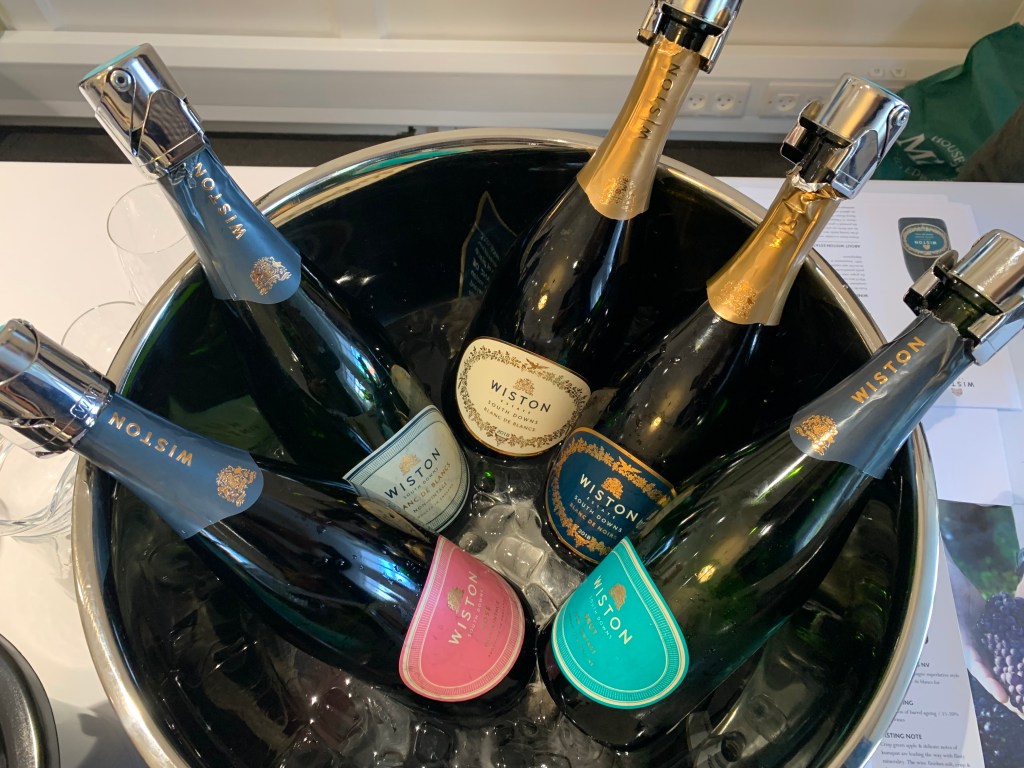
Wiston Blanc de Blancs displayed apply, cider-like aromas together with lemon, pastry and roasted almonds. The wine was nicely balanced between autolytics and fruit as well as between acidity and sugar levels.
Wiston Brut, a blend from 1/3 of each of the three varieties and degorged back in 2023. For a regular Brut NV, not made from 100% Chardonnay, it came across as quite cider or apple compote like, which I find quite appealing.
Wiston Blanc de Blancs 2018 saw 50% stainless steel and 50% used oak for the vinification, which was followed by 6 years on the yeast. I love the lemon curd touch to the wine. Very nice balance between the fruity and yeasty notes and the wine possesses great freshness.
Wiston Blanc de Noirs 2018 is 100% Pinot Noir. 100% of barrel fermentation in used barriques. The wine is quite yeasty (think a buttery croissant and roasted almonds) with baked pear and red apples blending in. As with the BdB there is a lovely freshness to the wine.
As far as the Danish market goes, one of the first to get attention was Gusbourne, whose wines remain popular here.

English still wines
Sparkling wine firmly established in an increasing number of markets, producers are turning some of their focus to still wines.
Given the marginal climate in England, such a change of focus is actually quite bold, as the production of high quality still wines require a higher degree of ripeness from the grape compared to those required for sparkling wines. You want a higher sugar content in the grapes (needed for fermenting into a higher alcohol level), greater concentration of more ripe aromatics and flavours from your grapes and lower levels of acids. All of this calls for a long growing season with more sunshine and higher temperatures and at best, you would say, that England enjoys just that in the very best of years.
With winegrowers and winemakers continuing to hone their skills, better and better wines are made, even from slightly less favourable vintages, and from what I have tasted recently, I am pretty excited to follow that development.
Early on in modern day winemaking, the Englishmen relied heavily on hybrid varieties such as Solaris, Reichensteiner, Madeleine Angevine, Rondo, Regent etc. as is the case in other climatically marginal wine growing countries and regions like the Nordics, the Baltics and Nova Scotia in Canada. The reason for this is the extra winter-hardiness and/or disease resistance of these grapes, which make them better fits for cool to cold climates and also the humid conditions in places such as Denmark.
A very good example of how interesting and innovative English wine produced fully and partially from hybrids can be in 2025 is Sandridge Barton in Dart Valley down in South Devon.
Sandridge Barton has been around all the way since 1981 but relocated ‘a few miles up the road’ in 2019 and come across as a very contemporary producer both in terms om labelling, preferred choice of grapes and a low intervention approach to winemaking. It taps really well into the modern, curious, environmentally aware consumer of which you will find many in most metropoles across Europe, including Copenhagen.
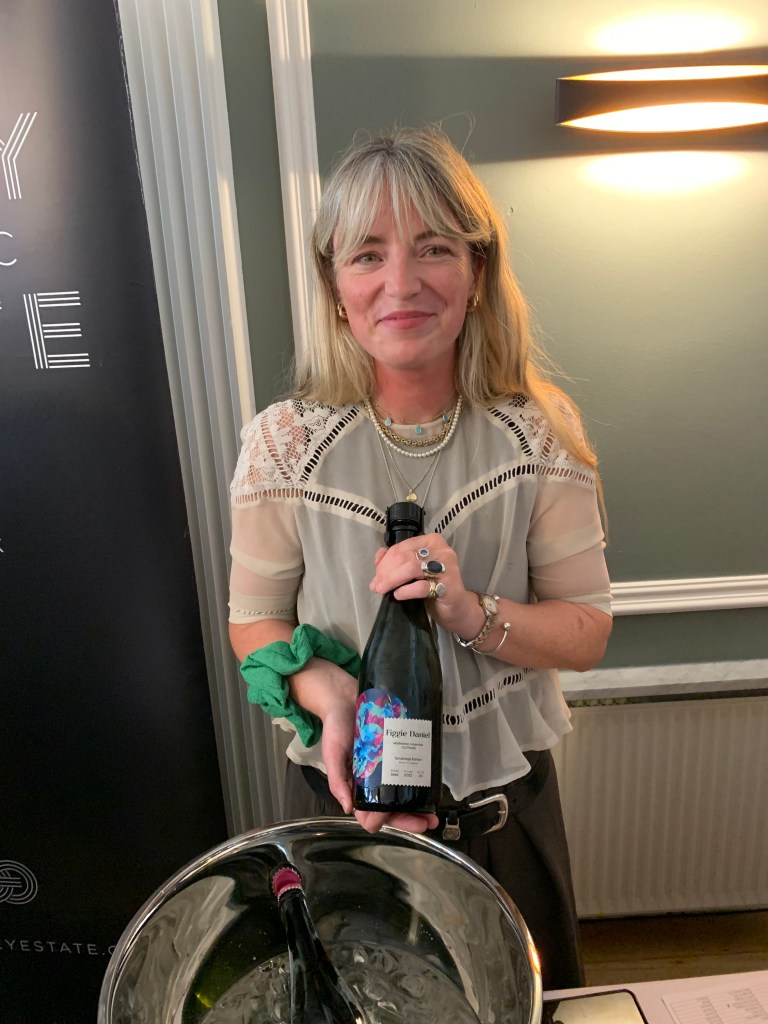
I can’t help loving Sandrige Barton’s ’Prosecco-like’ approach in their Figgie Daniel Madeleine Angevine Col Fondo.
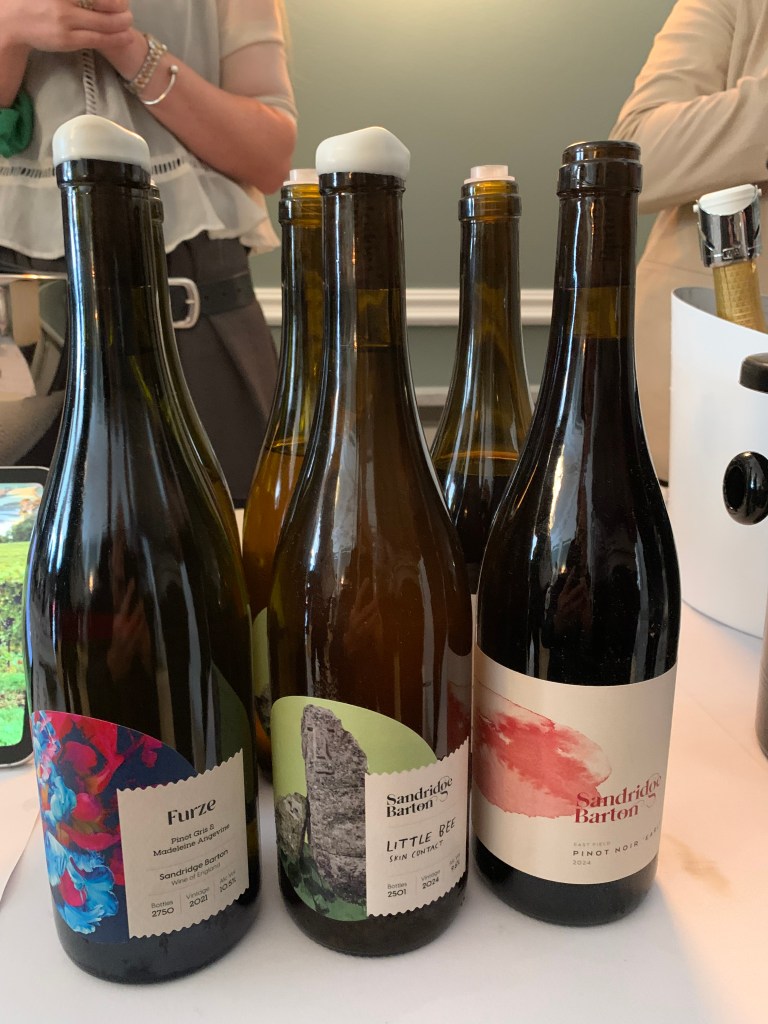
Their ‘Furze’ from Pinot Gris and Madeleine Angevine is fun to drink, as well. The spontaneously fermented wine, which has a cider-like feel to it, spent 18 months in 3rd and 4th used French barriques.
‘Little Bee’, made from Pinot Gris, saw 22 days of skin contact. Quite rosy colour with moderate tannins and pure fruit with notes of tea and smoke.
Sandridge Barton 2024 Pinot Noir Early is made from Pinot Precoce (or Frühburgunder, if you please). 40% whole clusters and punching down every 10 days. Red cherry, raspberry and red plum. A somewhat gamey feel to it. Very light bodied with pure red fruit.
In England, producers paying ever more attention to choosing otimum vineyard sites. Unsurprisingly, there is a good deal more to it than just matching the right soils with the right cultivars to produces a certain type of wine. In an unpredictable English climate, focal points include providing the vines with shelter from strong winds and at the same time optimal sun exposure for the best possible chance of ripening one’s grapes year in and year out.
The resemblance between the soils of Champagne and southern parts of England have long been established and quite a number of the producers established in recent decades have a long track record for selecting premium sites for their vineyards. Several of these are now – to different extends, obviously – turning their attention to producing still wines.
With an initial aspiration to rival the wines of Champagne, English wine producers have extensive experience with Chardonnay and Pinot Noir, so what would be more obvious than to produce still wines in a similar style to those of Burgundy.
Simpson’s Wine Estate leading the way for still wines
One prominent producer to have partly turned their focus on still wine, too, is Simpson’s in Kent, who Drinks Business reported are planning to dedicate as much as 60% of their grapes to the production of still wines, of which half of that is expected to be exported.
Simpson’s are still producing lovely sparkling wines from heir predominantly chalky soils, such as Chalklands NV, White Cliffs Blanc de Blancs and Flint Fields Blanc de Noirs.
As I talked and tasted my way through the sparkling lineup, it became obvious, that Simpson’s really would like you to pay a visit to their still wines, too… At Simpson’s they have produced still wines every year since 2018 and with all of that experience they want to turn warmer, sunnier summers like this years – 2025 saw harvest at Simpson’s starting two and a half week earlier than normal(!) – into beautiful Chardonnay and Pinot Noir such as Gravel Castle Chardonnay 2023 and Rabbit Hole 2023.
Now, who would have thought of a winery almost at the heart of London, but this, near Battersea Park, is where you find ex-Michelin star sommelier, ex-Flowers, de Montille, Mulderbosch and Ata Rangi, Sergio Verillo.
The grapes for Verillo’s wines come from selected vineyards in Essex, from growers who source high quality grapes from well-located vineyards.
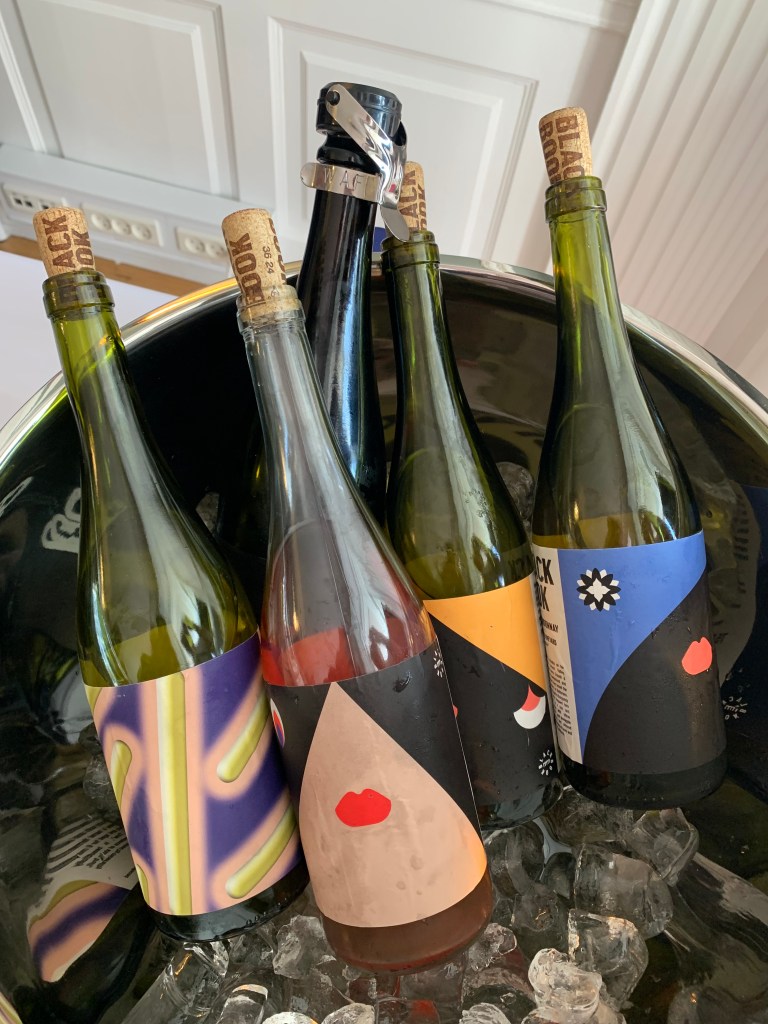
Chardonnay and Pinot Noir are focal varieties at Blackbook, but other, more experimental, things are tried out too, such as Sauvignac (Riesling x Sauvignon Blanc).
For Chardonnay Clayhill Vineyard, Verillo uses whole clusters and the wine ages in 25% new 3-500 litre oak barrels and the wine has a lovely balance between fruit and oak.
Chardonnay South Bank Vineyard is produced from a good handful of different clones and spends 2 years in 40% new oak and is obviously the more oaky of the two. This is definitely well built for cellaring.
Their 2022 Pinot Noir is highly appealing and beautifully balanced. Lovely cherry, black raspberry and plum and a fine dairy touch to it. Really well done.
So much is happening in England these days and probably, Sam Linter hits the nail spot on, that getting volumes up to make it all financially more viable is the barrier to overcome.
 LehmannLarsen.com