Talking about Denmark, would you even consider talking about wine?
Probably not. You would talk about Lego, Tivoli and Hans Christian Andersen – and more recently, Novo Nordisk – and this is all quite logical, since Denmark is located quite far to the north and at 56 degrees north, we sit way off the ‘ribbon of wine growing’ between 30 and 50 degrees north and south respectively.
But grapes are grown and wine is produced in Denmark – and we are getting better, as years go by, but don’t look to Denmark for the likes of Cabernet Sauvignon, Tempranillo and Grenache or oaky Californian Chardonnay styles. It’s too cool for these grapes and these styles of wine up here.
‘Anyone wanting to plant vines to grow grape and produce wine as far north as 56 degrees latitude must have lost their mind’, right? Well, defying expectations – and maybe even common sense – though, Denmark has a history as an official winemaking country under EU law dating back to the turn of the Millenium. A history, which obviously goes beyond that. Getting recognized by the EU is indeed quite an achievement for a country, located much farther north than any well-known wine region in the world.
The first commercial vintage in Denmark was 2001, only a year after gaining EU recognition and by 2020 there were around 100 commercial producers, many very small-scale, farming roughly 125 ha of vines, spread out quite a lot more, than one would expect.
Today, Denmark is very much a wine producing country, gaining increasingly more recognition and combining its bespoke culinary scene with rapidly developing wine tourism, and just maybe, Denmark appears as ‘The Ugly Duckling’ of the wine world, drawing parallels to the fairy tale of the famous Danish poet, Hans Christian Andersen.
Winds of change
We know from science, that grapes require more than 1,000 Growing Degree Days to ripen (GDD) and Denmark indeed lacks the GDD of classic wine regions. Historical data show, how 1961-1990 averaged only some 600 GDD and 1991-2020 roughly 700 GDD. With the ongoing climate changes, numbers will slowly but surely continue to grow.
Numbers vary significantly, even within a very small country such as Denmark, due to a vast coastal line, weather systems coming in from the west and the warming effect of the Gulf Stream, which moderates the climate and most significantly so in those central coastal areas, the same areas also experience larger amounts of sunshine hours warming up the surrounding bodies of water.
An example was 2022, which saw an average of 850-900 GDD in the warmer wine growing areas compared to a mere 550-600 in the colder, most windy parts of the country. And bear in mind, that 2022 was by and large ‘the warmest year we ever experienced, yet it is expected to be one of the coldest of the rest of our life!’
Precipitation in Denmark is around 800 mm, the challenge being, that rainfall in any quantity and intensity can occur throughout the growing season and during harvest.
July, as an example, may be completely dry as in 2018 or soaking wet as in 2023 and we could face up to 150 mm in a day’s time like big parts of Zealand and Funen got around the 22nd of July 2025 compared to an average of 66 mm for all of July.
Weather systems come in from the Nordic Sea, often bringing strong winds, further lowering temperatures, as well as more rainfall, than wine growers would like. The levels of precipitation of course keep sunshine hours down to a level, where wine growing is much more troublesome. That is the obvious reason, why we don’t see much wine growing in the central and western parts of Jutland.
But the best Danish producers are continuing to hone their skills in the vineyards and in the cellar and over the last decade I have witnessed continued improvements in the quality of Danish wines.
To this day, PIWI cultivars are the name of the game in Denmark. In broad terms, look for Solaris and increasingly also Souvignier Gris for whites and Rondo for reds, even if things are currently changing, as some producers such as By Stokkebye and Kalum are convinced, that eg. Pinot Noir is the future of Danish wine.

This could very well be correct. Take into consideration both the steep learning curve of the Danish producers and the climatic changes and do take a look at, how things are going in England, where vintners are more and more successful with the varieties known from Champagne and Bourgogne in spite of a rather marginal climate, even if somewhat warmer than that found in Denmark.
Erratic weather patterns
Another climatic factor to increasingly impact Danish viticulture is the utter unpredictability of the weather!
Across the world, and Denmark is no exception, we will have to get used to the fact, that with the climate changes we will experience over-all increasing temperatures as well as extremes becoming ever more extreme.
Hot summers will get increasingly more hot, wet seasons will become even wetter and in case of droughts, it will become more severe. Warmer temperatures could lead to earlier bud break, when late spring frosts would become even more of a threat, potential summer hail storms or torrential rain and floodings around harvest time.
Danish appellations
For good reasons, many people remain unaware, that Denmark even produces wine, yet it has four regional PGIs to its name in Jylland, Fyn, Sjælland and Bornholm respectively.
There is a concentration of producers in the areas near bodies of water such as Storebælt and Lillebælt. Such areas would include Røsnæs, Odsherred, both in Northwest Zealand, southwestern Zealand, eastern Funen and eastern Jutland. These are all areas with above average temperatures, average/above average hours of sunshine and below average precipitation. All of this combined with a moderating effect from the narrow belts, which heat up more rapidly than, say, Skagerak or Kattegat.
PDO Dons
Røsnæs, the northernmost of part of the beak shaping Kalundborg Fjord, was expected by many to become the first Danish PDO due a sunnier and drier climate than the Danish average, but instead the hard work of Sven Moesgaard at Skærsøgaard paid off and Dons near Kolding was eventually named a PDO for its sparkling wines in 2018.
Danish wine producers have become increasingly aware, that we actually have very good conditions to produce traditional method sparkling wines of a very good quality, and in 2018, the northern most PDO in all of Europe, Dons PDO, which is located north of Kolding in East Jutland, was a reality!
Dons is a PDO for sparkling wines only and obviously the wines have to meet strict criteria just as in any other PDO and for Dons, a defining parameter is a particular bright, Nordic acid profile as to demonstrate its northern origin. Wines have to be produced from particular varieties. With the EU approval of the production of wines from PIWI grapes such as Cabernet Cortis, Orion, Regent, Rondo and Solaris, Danish wine might have played an, even if ever so little, role in making grape growing in Europe a little bit greener and more sustainable for decades to come. At least I like to think so.
Skærsøgaard, the sole producer under the Dons appellation, fought for a long time for this recognition and continues to lead the way for Danish sparkling wines and the PDO wines of Skærsøgaard were very well received with high 80’s handed out by The Wine Advocate for the first two wines of the PDO to be reviewed by the magazine.
Extending the reign of the PIWI grapes
Modest temperatures and an over-all rather humid climate in Denmark make wine growing challenging, with both powdery and downey mildew as well as grey rot being severe challenges in the vineyards. And this on top of actually getting the grapes to ripen adequately.
This means, that growing classic Vitis vinifera varieties is generally not an option and hence, growers rely on PIWI grapes such as Rondo, Bolero and Regent for black varieties and Solaris, Souvignier Gris and Muscaris for green ones, just to give a few examples.
These varieties are bred to adapt to the marginal climate of Denmark and countries with similar marginal conditions. Two joint traits are, that they simply ripen faster and are less susceptible to fungal diseases in the vineyards.
Amongst the green varieties, Solaris is by far the most widespread in terms of planting as well as bottles produced and as years go by, it seems to get a somewhat more uniform expression, as I have witnessed over the years, serving as a judge at the annual evaluation of Danish wine.
No rules without exception and at Lilleø Vin, they utilize their rather unique meso climate to experiment with Riesling, Sauvignon Blanc and Pinot Gris and at the southwestern part of Møn, Kalum Winery have replanted their original 3,5 ha of PIWI grapes with Chardonnay, Pinot Noir and Meunier with an ambition to make use of their soils similar to those of Champagne and Burgundy to see if a similar style of still wines and sparkling could be produced. Only 1,000 Souvignier Gris vine were spared. Since the replanting, plantings have been increased to 16 ha.
For any foreseeable future, my advice to Danish wine producers would be sticking with your guns. Continuing to optimize and perfect making dry, crisp whites from Solaris & Friends seems the way to go – along with production of traditional method sparkling wines.
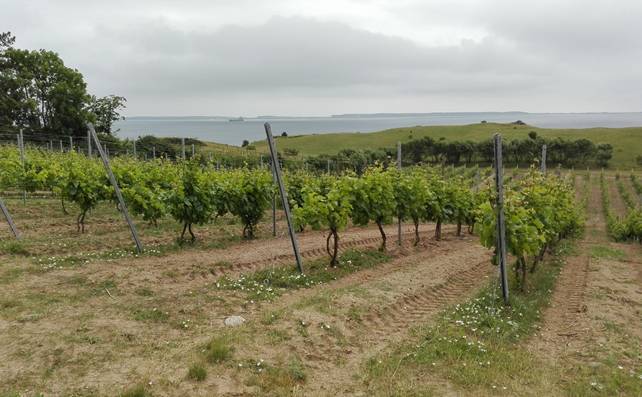
Solaris continues to be a starting point for Danish whites and you find very good examples in different areas. Dyrehøj in Røsnæs as well as Vejrhøj and Ørnberg in Odsherred provide good and accessible examples from the eastern parts of Denmark and on Fyn, By Stokkebye produces a very nice edition.
By Stokkebye is also highly interesting to pay a visit to experience their work with Nova Scotia’s l’Acadie Blanc for sparklings and Ukranian-bred hybrid, Golubok for liqueur wines.
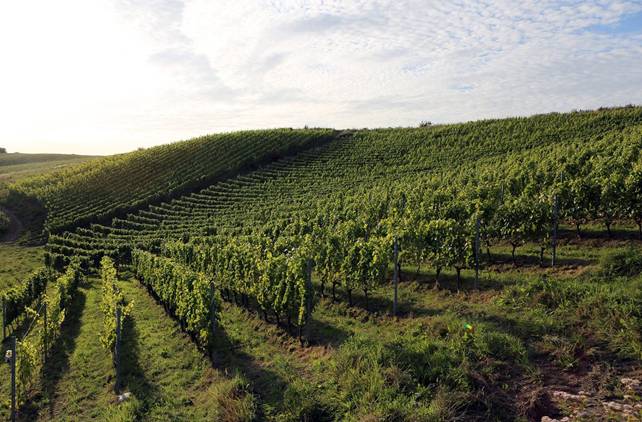
Insisting on reds, even in Denmark? Look at Sune Albertsen at Njord. Beautiful Pinot Précoce, arguably the best red wine to be produced in Denmark, planted only at the most favourable plots in the vineyard, is produced in the absolute centre of Zealand. Meticulous site selection is crucial, as optimal sun exposure is needed to ripen Pinot Précoce this far north! Anyway, this is a glimpse of, what Danish red could and should be in mid-range future! Incredible elegant and fragrant, yet complex reds.
Fans of the likes of Amarone, pay a visit to Jesper Rye Jensen at Vesterhave, beautifully located near public summer’s favourite, Karrebæksminde.
Maybe there is hope, too, for varieties such as Maréchal Foch. I enjoyed some pretty beautiful 1999 and 2001 Maréchal Foch in Nova Scotia a few and Nova Scotia is in a pretty marginal climate, too!
Well, there are more reasons than one, why to stick to the PIWI grapes in a foreseeable future.
Research continues to show, that even if Solaris etc. were bred to cope with a marginal climate, they may be a more generally viable solution in a wine world with ongoing and escalating climate changes.
In Champagne, the hybrid variety Voltis has been approved (no more than 5% of a grower’s vineyards) and in Trentino, Solaris and Souvignier Gris are amongst the varieties selected for the Vevir project to “test for productivity, disease tolerance and oenological potential” – www.civitadelbere.com
With all of the research done in Champagne, Bordeaux, Trentino, Emilia-Romagna etc., so much knowledge will be available, for Danish wine growers to use to improve the quality of their wines in the next decades.
More than grapes – taking advantage of the excellent Danish fruit
Not too far away from the second biggest city of Denmark, Århus, is the peninsula of Djursland, where you find the absolutely stunning area of Mols Bjerge. As beautiful as the area is, this article is about alcoholic beverages.
The reason for this is Andersen. No, not Hans Christian Andersen, the world-famous Danish writer, although the story of winemaker Mads Groom Andersen and Andersen Winery does indeed have a fairy tale to tell.
The Danish climate is marginal for ripening grapes, but the cool nights and the vast number of hours of sunshine is optimal for growing super flavourful fruit – and from fruit beautiful ‘fruit wine’ is produced.
A well-known Danish speciality is ‘kirsebærvin’, wine made from cherries. On the island of Lolland Frederiksdal is well-known internationally and rightly so. They produce a number of very personal wines in different styles including ‘Sur lie’, ‘Rancio’, sparkling and liqueur.
The fact, that the first Danish DOP was dedicated to sparkling wines, was no coincidence, and now we return to Mols Bjerge and Andersen Winery.
Back in 2009 Andersen started an experiment with the production of wines from apples from his own garden and a few years later he planted a vineyard to experiment with sparkling wines from grapes – just like in Champagne. By 2015 the quality was high enough to increase the production begin the production of wine from a wider array of fruit – today sparkling fruit wines are made from red currants, black currants, rhubarb, cherries as well as different sorts of apples.
The aim of Andersen Winery was always to produce wines with the potential of being served as an aperitif, just like a glass of champagne, but the wines should also be worthy of accompanying high end gastronomy.
To this day their ‘Elmsfeuer’ made from rhubarb remains their most sought-after wine, but ‘Ben A’, made from blackcurrants, and ‘Stevns’, produced from of a very specific cherry, called ‘Stevnsbær’, are well worth seeking out, too.
Medals for Denmark
Competing against other countries’ PIWI varieties, Danish wines do remarkably well.
Earlier this year, Dyrehøj Vingård – the biggest wine producer in Denmark – and Skærsøgaard could report of more than solid harvests from PIWI Wine Awards International, both logging a total of 7 medals out of 23 medals awarded to Danish wines in total.
Dyrehøj achieved no less than 6 Gold medals and 1 Silver with ratings up to 95 points and fellow Røsnæs winery, STUB Vingård, brought home a gold medal for 2021 STUB Sparkling Stallion – Johanitter and Skærsøgaard received a massive 96 points and a Grand Gold medal for the 2020 Skærsøgaard DONS Blanc de Noir Brut amongst their 7 medals.
Danish wine is definitely ready to take on the rest of the ‘conventionel’ wine world in competition, too, and has slowly started to do so, as 2025 marked the debut of Danish wine at Le Mondial des Vins Blancs – a highly successful debut which saw a gold medal handed out to PdC (Pinot de Charlotte, a Pineau de Charentes-inspired wine) by Agger from Agger Vin in Haarby on Fyn.
Also, the first Danish medal at Decanter World Wine Awards was brought home in 2025, as Kalum Winery on the island of Møn won a bronze medal for their Steel Brut de Mon 2021.
Where to find Danish wine
Danish wine is sold through multi-facetted distribution channels, just as anywhere in the world.
Some producers sell their wines through specialist shops, with only the biggest producers even considering working with a distributor, wine is sold through web shops as well as directly from the winery door, especially with wine-tourism becoming increasingly more important to Denmark as part as the whole Danish gastronomic adventure.
The final leg of getting to the customers is obviously having the wines listed in restaurants locally and nationally and producers such as Njord, Ørnberg and By Stokkebye would be worth asking for, if dining at a top end restaurant.
Denmark’s sparkling future
The near future for Danish wine might indeed very well be sparkling – in more ways than one.
Fact is, that if we have anything aplenty in grapes grown in Denmark, that would be acidity and if growers succeed in getting the fruit aromas and flavours just ripe, they have everything that traditional method sparkling wine producers could ever ask for!
Champagne was perfectly positioned to make premium quality traditional method sparkling wines already more than a century ago. There are quite a few reasons for their success, including first class grape varieties, but a very important reason is the region being located in a cool climate wine growing area in terms of the classic, international varieties. Pinot Noir and Chardonnay are in a perfect location to ripen sufficiently to produce sparkling wines, whereas Champagne is considered too cold for the grapes to produce still wines. At least for now!
To me, white wines from PIWI varieties and sparkling wines, is Danish wine playing to its own strengths!
 LehmannLarsen.com