Mantineia in western Peloponnese is both the birthplace and the homeland of the highly interesting Moschofilero variety, a variety probably originating from this very area, where it was allegedly mentioned already in the early 17th century.
The vine of Pausanias, which is believed by many to be the oldest vine in the world, is located in the area, some 10 km outside Kleitoria on the Kleitoria-Tripoli road, pointing to a very long tradition of viticulture in Mantineia.
Viticulture in Mantineia does indeed date back to ancient times as evidenced by numerous archaeological finds, linking the area with wine and the worship of Dionysos, the Greek god of wine.
In ancient times, Aristoteles and Theophrastus refer to the wines of Arcadia (Mantineia is a region of the prefecture of Arcadia), whose residents worshiped the god Panas as much as they worshiped Dionysos (today probably more widely well-known), who was well known for being celebrated through drinking wine, singing, dancing, and feasting.
Moschofilero is considered one of Greece’s top white-wine varieties and one, for which it is not unusual to be compared to e.g. Traminer and Muscat and Moschofilero indeed tends to produce aromatic, light-bodied, fresh, citrus scented white wines with quite high acid, moderate alcohol levels, traits shared with many a Traminer or Muscat.
Wines made under the Mantinia PDO are required to contain at least 85 percent Moschofilero, although in practice many of these are 100%. Under the more generic PGI designations that cover the region, Moschofilero can be found blended with Asproudes, Savatiano and Roditis, usually to add fresh acidity to the wines.
Moschofilero is productive and high-yielding, late-ripening variety and the high-altitude terroir of Mantineia (600 m.a.s.l. and above) does make for very good wines given the long growing season with high diurnal range, which preserves the acid in the grapes and enhances both the aromas and flavours.
Particularly cold vintages such as e.g. 2004 will put some vineyards at risk of not maturing at all.
What is quite interesting about Moschofilero, as with e.g. Pinot Gris and Roditis to name a few varieties to share this feature, is that it is a pink-skinned variety and to make the white wines, for which the variety is known, skins are removed, just as is seen with e.g. Pinot Noir and Meunier in the production of Champagne.
Some producers, however, choose to utilize the pink skins of Moschofilero to produce orange wine and the new rosé-orange (or Rorange).
One such producer is the historical family winery Kalogris.
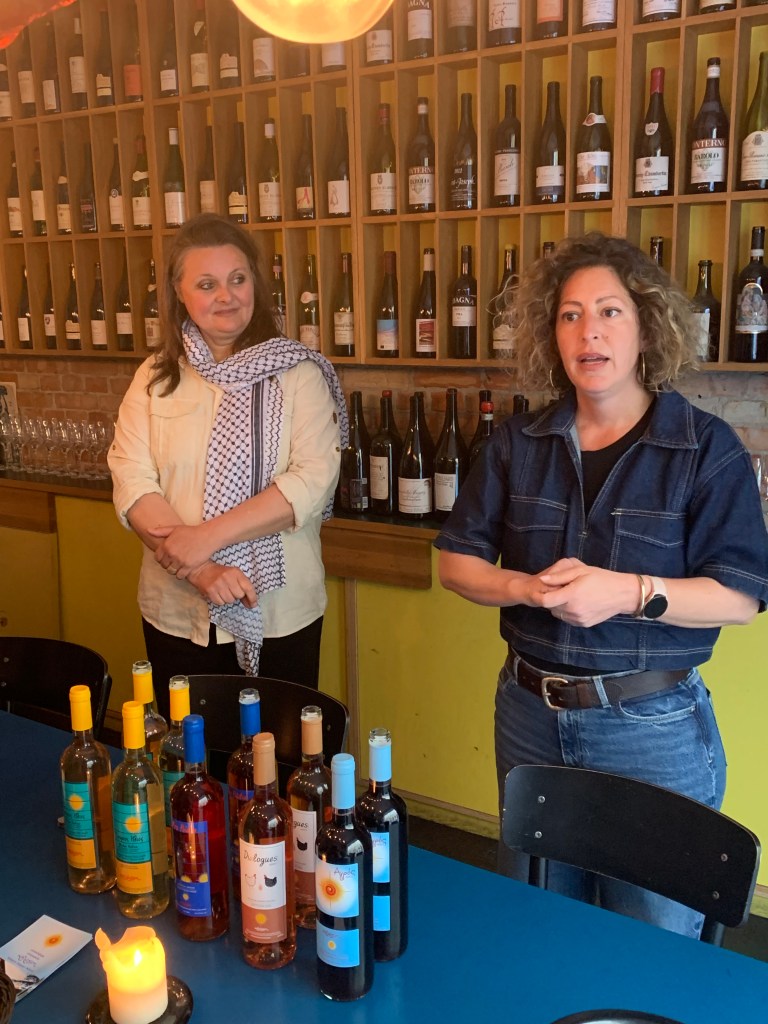
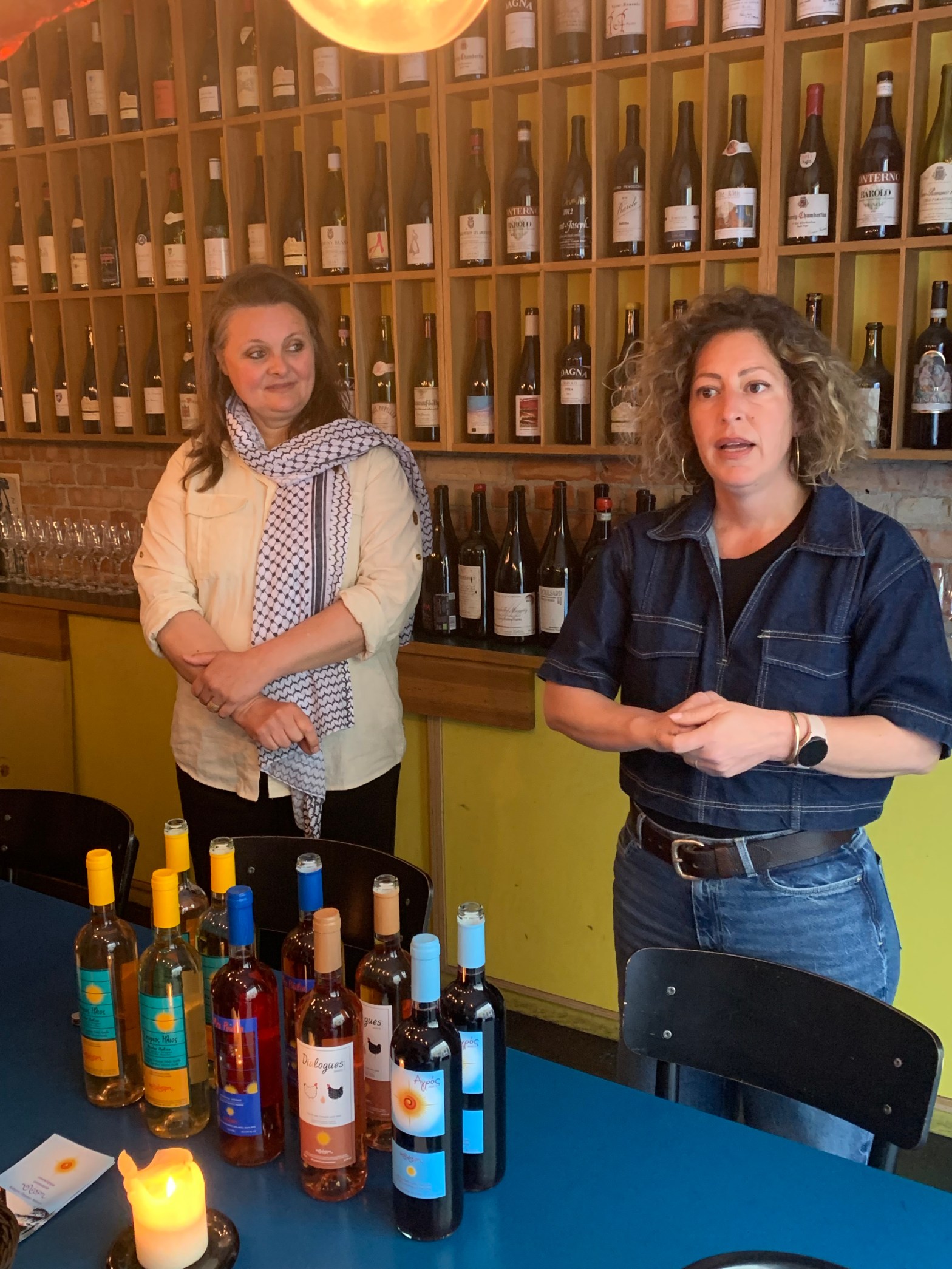
Grapes have been grown in Mantinia by the Kalogris family since the 1870s, they have traced, and today Evangelos and his wife, Christina, run the company together with their two daughters, Sandy and Tatiana, and recently the highly charismatic Sandy paid a visit to Copenhagen to put the family’s delicious wines on display.
Kalogris winery was established in 1981 with Sandy’s great-grandfather handing the traditional family house over to her father, Evangelos, under the condition, that he would convert it to a winery that would accept visitors. Evangelos kept his promise to renovate the now 155 years old house, and since 1998, Kalogris wine has been open the public and oenotourism.
The family cultivate a total of just 3 ha under vines, planted on clay-loam soils some 30 km away from the coast and at 680 meters above sea level in an area, where mountains surround the vineyards. The mountains protect the vineyards for excessive temperatures, which might cause stress to the vines. Also, the mountains create a protective micro climate, which protects the vineyards against extreme weather conditions. The soils in combination with dews during nights keep the grapes healthy during the droughts and climate changes of the 21st century. Of these, 2,7 ha is planted with Moschofilero and the rest is made up by Cabernet Sauvignon and Merlot. The vines were planted between 1980 and 1985 except from the 60+ years old vines producing grapes for Dialogues, Kalogris’ orange wine.
At Kalogris, labours were always performed manually by the family, from pruning all the way through to harvesting and the eventual bottling of the wine, building a personal relation between human and vine. In general, the Kalogris are very much ‘anti-machines’ and as an example, they use a pneumatic press, which is more gentle to the grapes but also much more labour-intensive. Grape growing has been organic since more than 40 years. ‘In fact, Evangelos Kalogris is considered one of the pioneers of organic winemaking and when the first certification, DIO, emerged in 1991, he was one of the very first to get the certification’, explains Sandy Kalogris.
Winemaking was always traditional, with wild fermentations and mild intervention and as Sandy explains, Evangelos took on natural winemaking practices already back in 1986!
One not so traditional practise, though, is playing classical music and rock’n’roll as well as talking to the vines and wines. This, however, is something, Sandy speaks quite passionately about. The purpose is to keep the grapes calm and happy during the growing season and for the rock’n’roll to boost them before harvest.
The philosophy is, that the vines hear and sense everything, and hence all the personal love and energy given to them by the workers in the vineyard is given back in the shape of ripe grapes.
Quite interesting studies were performed early this century on music’s influence on our perception of a wine’s taste. Along a similar line, studies have shown, how fermentation can be positively impacted by classical music. Tests have been done of the impact of different types of music in the vineyard, too, pointing to positive effects from classical music.
The practise of playing music in the vineyard and cellar is not too uncommon, these days. In South Africa, de Morgenzon plays Baroque music 24/7 and Cyril de Benoist of Domaine du Nouzay in Sancerre has loudspeakers throughout the vineyards, playing classical music. Other producers even play or sing to the vines, themselves.
For the Kalogris, working in and together with the nature is what life is about. They feel passionately about protecting nature and maintaining a high degree of biodiversity and on their property, they have lots of species of trees, vegetables, wild flora and edibles. Biodiversity nurtures the soil with nutrients and mitigates need for fertilizers. To winegrowing, biodiversity is widely recognized to improve the soil, and to aid the pollination, all to the greater good of the grapes.
Keeping yields low and relying on natural processes allow Kalogris to market perfectly well made, fresh and aromatic wines from Moschofilero. Wines that drink beautifully.
Vintages vary, and so they do in Mantinia, and with different weather in different years, the result is obvious wines with different profiles. And just how differently, grapes may develop, was illustrated in 2024. Throughout the year, temperatures were much higher than normally and as a result, Moschofilero ripened a full 20 days earlier than regularly.

These higher temperatures continued through the first week of harvest, after which they dropped to more normal levels, slowing down the ripening of the remaining grapes.
Kalogris gambled, that no rain would occur, and postponed the remainder of the harvest – and they were paid off. Hence, they had two separate harvests of their 2,7 ha plantings of Moschofilero vines within a time span of 25 days, meaning a ‘regular’ harvest and a late harvest made for two very different expressions of the same wine, O Kirios Ilios or ‘Mister Helios’ (Mister Sun), their white Moschofilero.
Just by the look of the wines, you know they will be different from each other, since the late harvest is rather pinkish in comparison to the ‘normal’ harvest, which has a colour, more widely associated with white wines. Sandy Kalogris explains, how this is quite normal for Moschofilero, since the prolonged ripening allows for darker colours in the skin, which translates into the colour of the most, once the grapes are pressed.
One would expect a higher level of alcohol or higher levels of residual sugar from later harvested grapes, just as another common trait for late harvest wines would be lower acidity, which corresponds to the higher levels of sugar in the grapes.
In the case of the later harvested Mr. Helios, it is indeed lower in acidity and higher in residual sugar, but the increased sugar levels are barely detectable in the glass.
Mister Helios ferments on the wild yeasts and only in stainless steel with temperatures kept low to preserve the fresh fruit characteristics, which consist of stone fruits and floral notes, to which one might add a rosewater-like touch and a slight oxidative note on the nose, adding complexity to the wine.
It is quite interesting, how the palest, most ‘white’ version, is more lemony in its citrus aromas, with the ‘gris’ version leaning more towards red grapefruit, maybe even a hint of blood orange.
These are wines to be paired with food heavy in herbs, spices, oil and lemon – and I would especially think vegetable or fish dishes in the Mediterranean Meze style.
Moschofilero is commonly sent on the market non-aged, not to mask the fresh fruit, but you may come across ambitious versions, which may have seen both lees stirring and barrel aging and Kalogris produces barrel aged wine, as well.
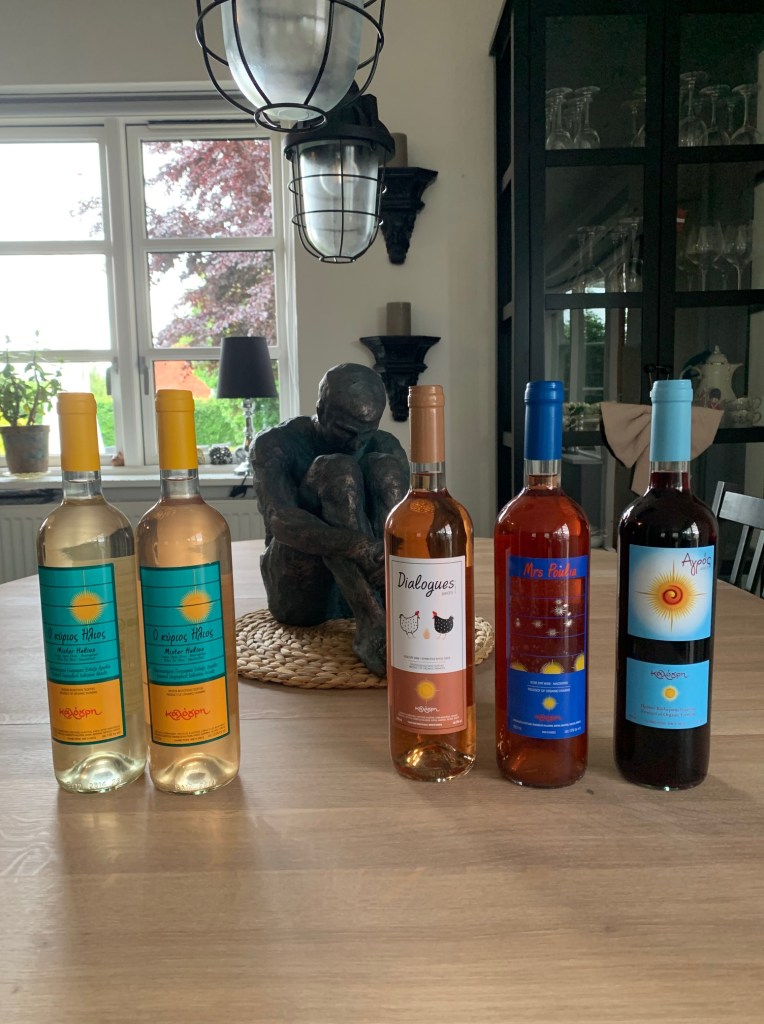
Kalogris produces an orange wine, Dialogues – orange wine, which as a category, is not clearly defined and hence not very homogenic.
Wines are produced from the range of varieties, normally used for the production of white wines, but are given a certain amount of maceration before removing the skins and this process changes the style of the wine. The fruit profile chances and new aromatics would join in. Also, the wine typically gets a tannic structure, which you would normally associate with reds.
Some grapes don’t yield much colour or tannins, or they don’t offer much transition of flavour and taste. Also, some wines may get a few days of maceration, if that much, whereas others may see close to a full year. Obviously, this leads to great diversity.
Dialogues is made from old vines of about 60 years of age and goes through a moderate 15 days of maceration and sits 18 months in old, small oak barrels.
Looking at the colour of the wine, the pinkish nature of the colour of the skins on Moschofilero shows.
Dialogures’ moderate tannic structure makes it sensible to compare it to an aged white more than an orange wine, but who is counting? This is an amazing wine!
Of course, the innovative Kalogris has a taken on the new category of rosé-orange, or ‘rorange’, as well.
Mrs. Poúlia saw 15 days of maceration in stainless steel with no temperature control. Wild yeast fermentation, no filtration or fining and just a minimum application of suplhur at bottling. Compared to e.g. Dialogues, Mrs. Poúlia didn’t spend 18 months in the barrel.
If I were to define it with just one word, that would be blood-orange with floral aromas blending in. Beautifully crisp with a salty sensation to it.
Agros (literally, meaning ‘field’) is a lovely light single vineyard red, made up from a 60/40 blend of Cabernet Sauvignon and Moschofilero. In the vineyard, each row is half Moschofilero and half Cabernet Sauvignon.
‘One-day harvest only’ is indeed an achievement, since Cabernet Sauvignon ripens some 20 days ahead of Moschofilero. So, getting that timing of overly ripe Cabernet Sauvignon and regularly ripned Moschofilero right is no easy task!
Fermentation takes place in a small one-ton tank with manual punching down three times a day until the fermentation is complete.
The free run juice ferments in stainless steel and ages in 8-9 years old oak barrels and sits on its fine lees for some 3-4 months.
The wine is dry with a refreshing acidity to it and aromatics centering around blood-orange and cherry with salt liquorice blending in.
Right now, summer is here, which for many people spells a visit to Greece. Are you not planning on going to Greece, the wines of Kalogris would be an excellent choice to add the bit of that Greek summer’s vibe to summers spent at home.
 LehmannLarsen.com