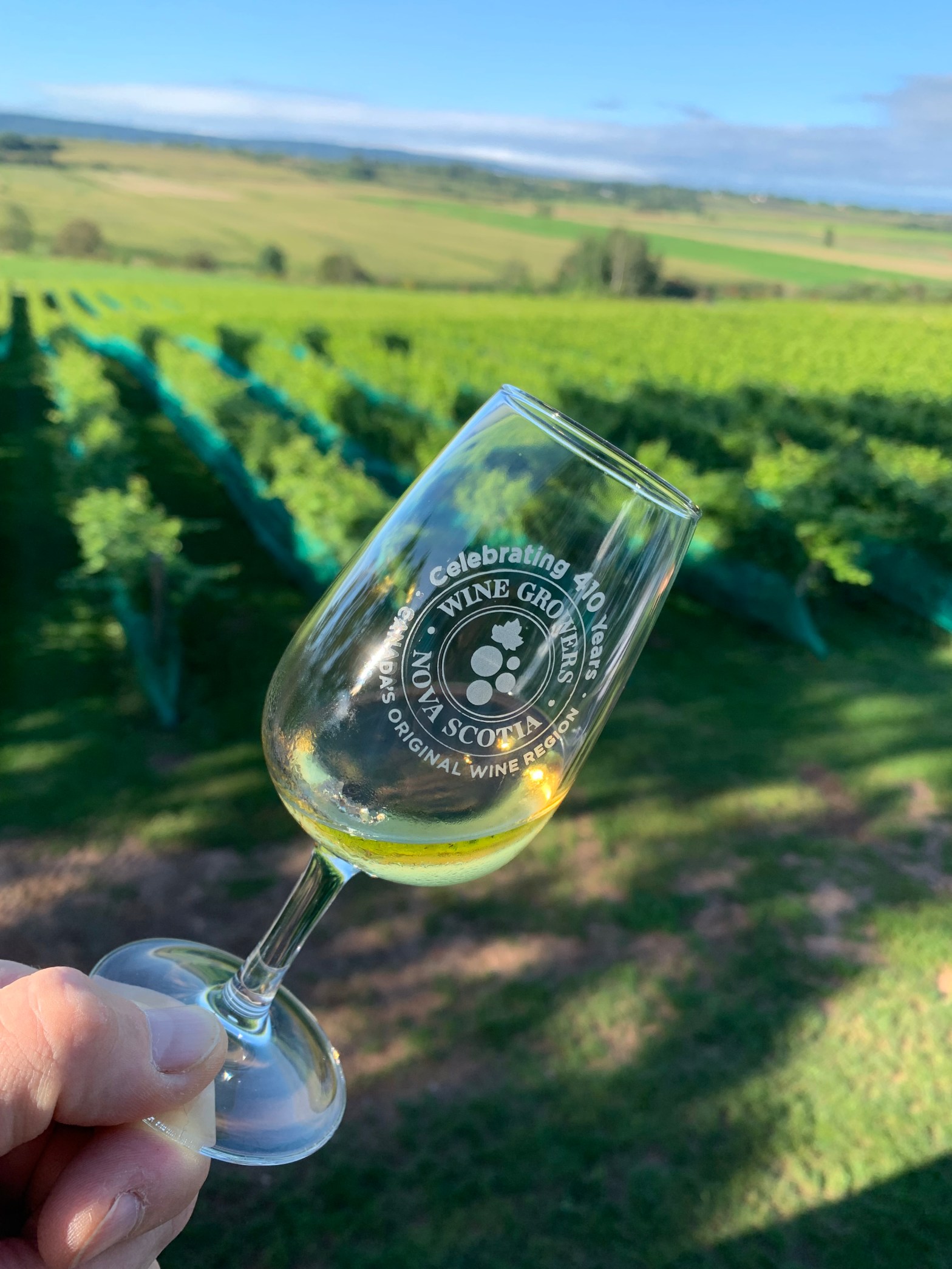
Flying in from London, Halifax is easily accessible, and Nova Scotia is such a lovely place to visit.
Beautiful, rugged coastlines, crazy good sea food and the super charming city of Halifax with its rich history, which you feel everywhere. Along the waterfront with its many monuments, the Public Gardens and the Citadel, which has been so crucial to the naval defense of the area. Halifax alone is worth visiting.

What is much less well known to most people, is just how interesting it is to explore Nova Scotian wine!
If Canadian wine is merely a bucket on the world-wide wine scene, Nova Scotian could be considered a drop in that bucket. The sheer size – or lack of such – makes it all the more exciting to learn more about. A few numbers to illustrate: In 2019, 638 Canada wineries produced 21 million cases of 12 bottles, only 211,000 of which were produced by Nova Scotia’s 19 wineries.
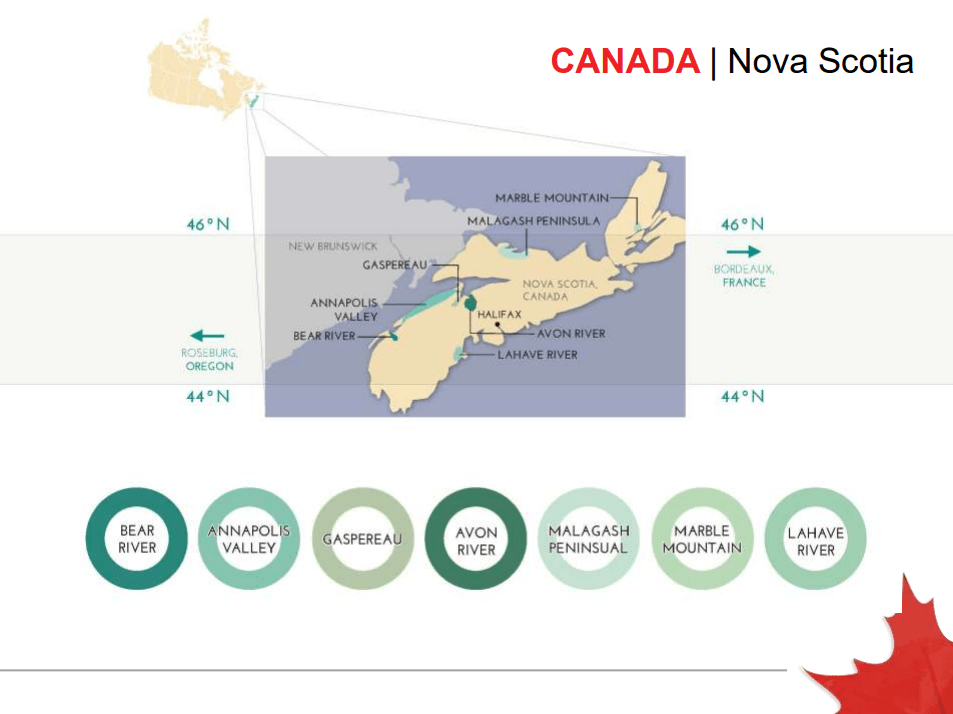
Nova Scotia, in the far east of Canada – actually in the Atlantic Ocean, rather than on the coast of it – is definitely the epitome of cool climate wine growing in Canada, and to this day it consists of 7 regions with the Annapolis Valley/Gaspereau/Avon River area being the most important with 10 wineries within 10 km. A total of 58 growers harvest grapes from a total of roughly 1,500 ha under vine.
People tend to think of Nova Scotia as an extremely northerly location on the cusp of growing wine, but in fact it is located just a bit farther north than Bordeaux at 45º latitude – yet with a completely different climate – and the entire region is surrounded by the Atlantic with the moderating (warming) effects of the Gulf Stream.
A highly important climatic factor is the tides with Bay of Fundy having the world’s biggest tidal shifts at as much as 16 meters, shifts which bring in cool summer breezes and leaves large bodies of water unfrozen during winter. Both factors help moderate the climate and aids wine growing in Nova Scotia.
Vineyards are never more than 20 km away from the ocean and are planted on ancient seabed soils. The soils are predominantly formed and shaped by glacial movements.
To fully understand Nova Scotia and its wine sector, you first need to know about the Acadians.
The Acadians were initially 70 Frenchmen from La Rochelle in Western France, who set sail way back in 1604 to arrive at Annapolis Royal in Nova Scotia, or Acadie, as they called the area, in 1605. Within a few years, the Acadians took on growing vines, either from Vitis vinifera which they brought with them from Europe or from Vitis labrusca and Vitis riparia cultivars.

The Acadians dug dikes to prevent the otherwise inevitable flooding caused by the tides, and in the process, they unveiled precious, fertile agricultural soil.
Would grape growing even be possible, had it not been for the Acadians?
I talked to Professor Emeritus Graham Daborn from Acadia University in Wolfville about the tides and the dikes built by the Acadians.
It appears, it would have been.
What has happened over the last 13,000 years or so is of much greater importance to the Annapolis Valley as we know it today.
Back in those days, the area was covered by a thick layer of ice and as it started to melt, the sea started to rise.
Around 4,000 years ago the shape of the Bay of Fundy changed. It used to be a bay with the Minas Basin being a lake, but as the sea rose, the wall to the Minas Basin broke and as a result we have seen these enormous tides at eg. Blomidon Beach.
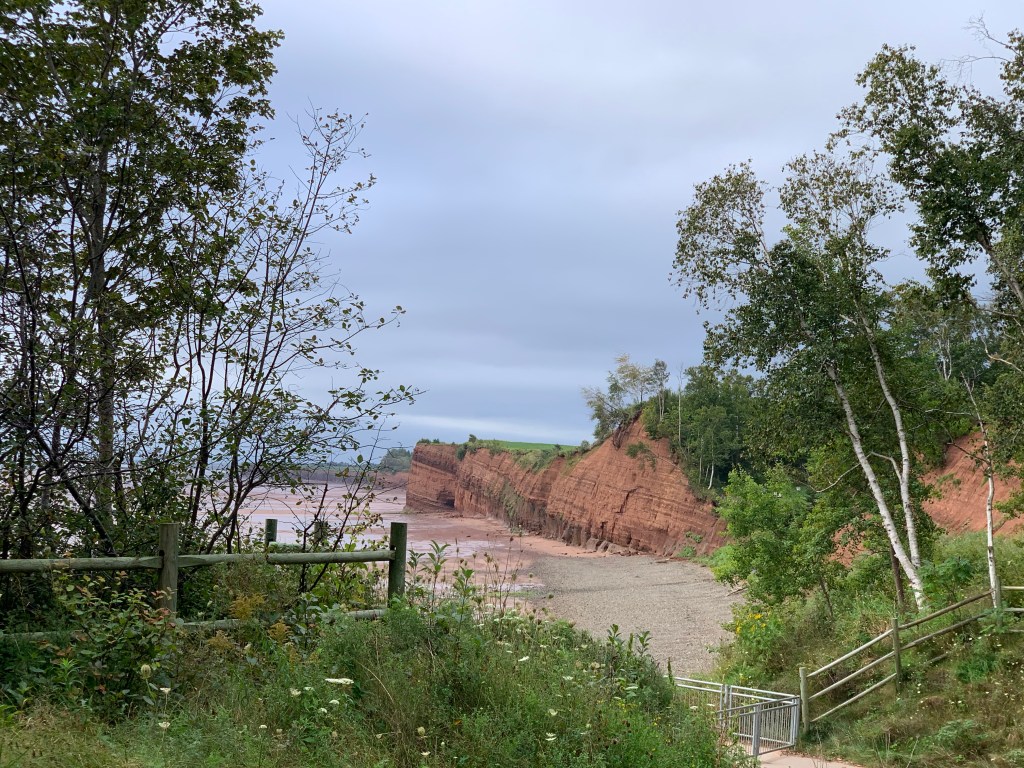
As the climatic changes continue, the Gulf of Maine has seen temperatures rising roughly 2 degrees over the last 30 or 40 years and as water heats up, it expands and this – at least partially – explains the continuing increase of the tidal shifts.
For the increasing tidal shifts to actually have an added effect on wine growing in Nova Scotia, vineyards would have to be planted even closer to the coast. Even at Planters Ridge with vineyards very close to dikes, these dikes were only dug much later by the New England Planters in the early 19th century.
On another note, it does indeed make tons of sense to try to take advantage of the tidal shifts to convert those massive amounts of kinetic energy provided by the tidal shifts into electricity. Turbines were indeed put up at Digby, only destroyed by the incredible power of the water masses!
With the current energy transformation into more environmentally friendly green energy, the last word was not said on this topic.
Let us once again travel back in time to a time when the English and the French were at war.
The Acadians refused to swear allegiance to the English and in return they were deported to places as far as Louisiana… Quite a few made their way back home to Nova Scotia, for some it took as long as 50 years…! Today, numerous Acadian settlements are found around Nova Scotia and The Grand Pré Historical Site is an amazing opportunity to learn much more about the Acadians and their history.

Back to wine growing and production.
So many grape varieties are grown in Nova Scotia – but let’s be fair: L’Acadie Blanc rules here, taking up about 1/3 of the acreage. ‘Why is L’Acadie Blanc so dominant?’, you might ask.
Over the past 150 years or so, intensive research has been done, as to which varieties to plant in Nova Scotia.
Of course, Vitis vinifera cultivars were considered and of course phylloxera and the havoc caused by it in Europe in the late 19th century was taken into account. Furthermore, winters in Nova Scotia can be bitterly cold (average minimum temperatures during the 1960’s was -25°C with an absolute low at -31°C…). For those reasons quite a few cultivars were decided against.
Recent climatic changes have seen a noticeable increase in growing days in Nova Scotia with spring frosts these days ending earlier in May than previously and autumn frosts may now occur once again from mid-October.
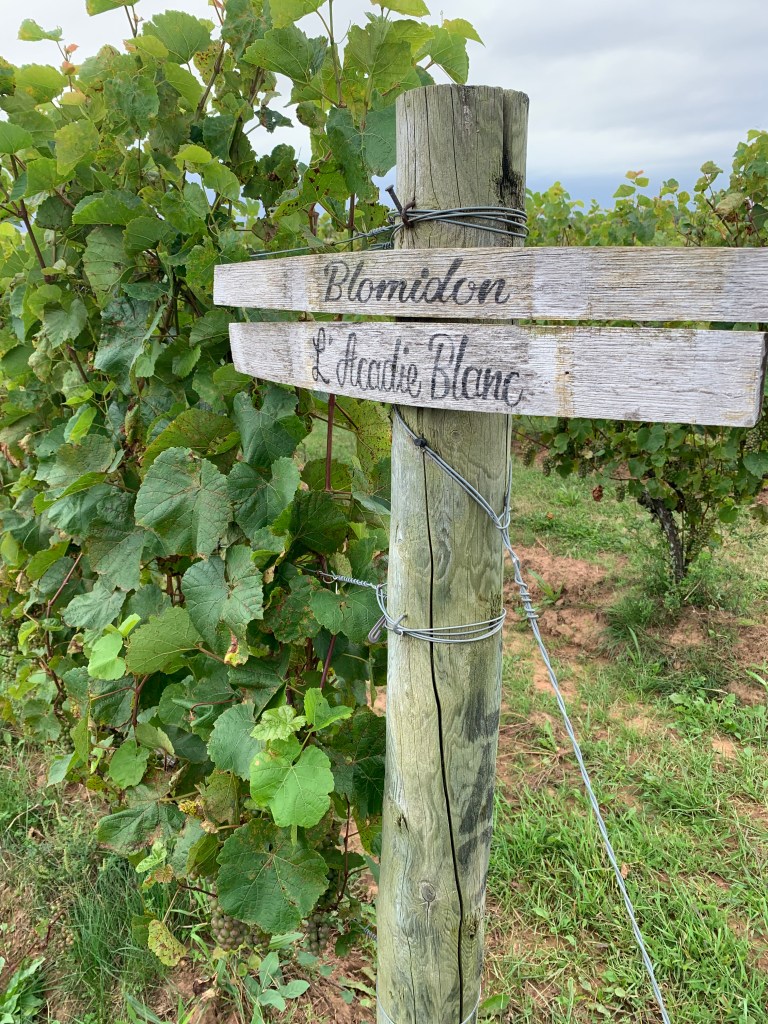
The solution turned out to be the hardy L’Acadie Blanc, a hybrid of the Vineland Research Centre from 1953, by then named V.53621, a grape, whose parentage is too comprehensive to be laid out here. By 1978, V.53261 was obsolete in Ontario and by that time tests were already made in Nova Scotia by Donald Craig of Kentville Research Center. V.3261 went on to be named L’Acadie Blanc by Roger Dial, who went on to release the very first commercial wine of Nova Scotia at Domaine de Grand Pré in 1980.
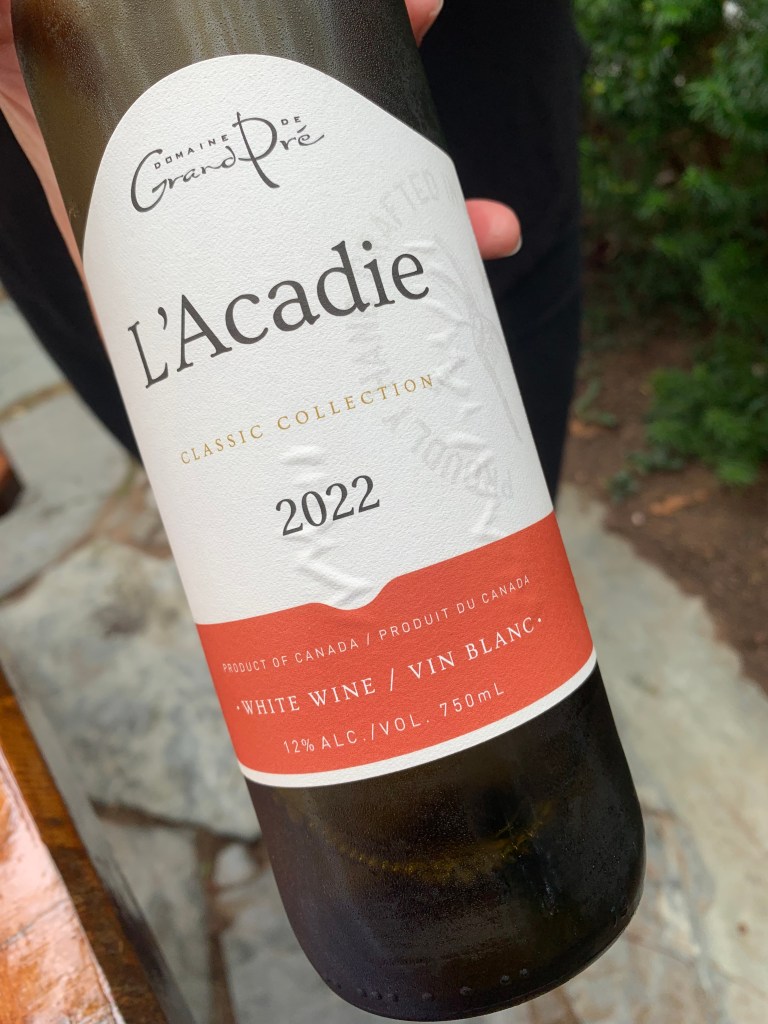
The notoriously high tides bring with them strong winds, which help to lower disease pressure and at the same time L’Acadie Blanc has loose bunches and medium-thick skins – an ideal combination for the grape to grow and thrive in the humid Atlantic summer.
That L’Acadie is indeed hardy, was proved only this winter, when the Polar Vortex Collapse of February 3rd 2023 saw temperatures dropping from 3°C to -26°C. Remember, that most Vitis vinifera would be killed from temperatures dropping much below -20°C… L’Acadie Blanc did much better than the Vitis vinifera planted alongside it in Nova Scotia’s vineyards.
Producers talked to me about losing as much as 80% of Chardonnay or even 100% of Pinot Noir vines – so maybe the decision to plant L’Acadie Blanc wasn’t so ill advised at all.
L’Acadie Blanc was first launched as a wine by Domaine de Grand Pré half a century ago and to date it is widely accepted as the best expression of Nova Scotia.
Tidal Bay
Every wine region aspires to have a wine that stands out and is widely recognized for defining what the region does best, and Nova Scotia wines are best known for their fresh and bright style.
With this in mind, Nova Scotia developed a signature wine that revealed these characteristics, and so began Tidal Bay. A wine with Nova Scotian character, Tidal Bay intends to reflect the terroir of its birthplace, including the cooler climate and the coastal breezes. The name of course reflects the maritime influence and the enormous tidal shifts of the area.
Officially launched in June 2012, Tidal Bay became the first true appellation wine in Nova Scotia with specific standards to be followed, and as such Tidal Bay was a North American one-of-a-kind. The whole concept of such strict rules applying to winemaking continues to be much more well-known in and associated with European wine regions.
The standards for Tidal Bay cover everything from growing over maximum levels of residual sugar and minimum levels of total acidity to bottling and they have been created by a committee of winemakers, sommeliers and wine experts.
Producers of Tidal Bay, however, are allowed to express their individuality and hence each wine is slightly different. The producers, unlike what you see in some of the more established wine regions of the world, work together and help each other regularly to support the growth and development of the wine region over all.
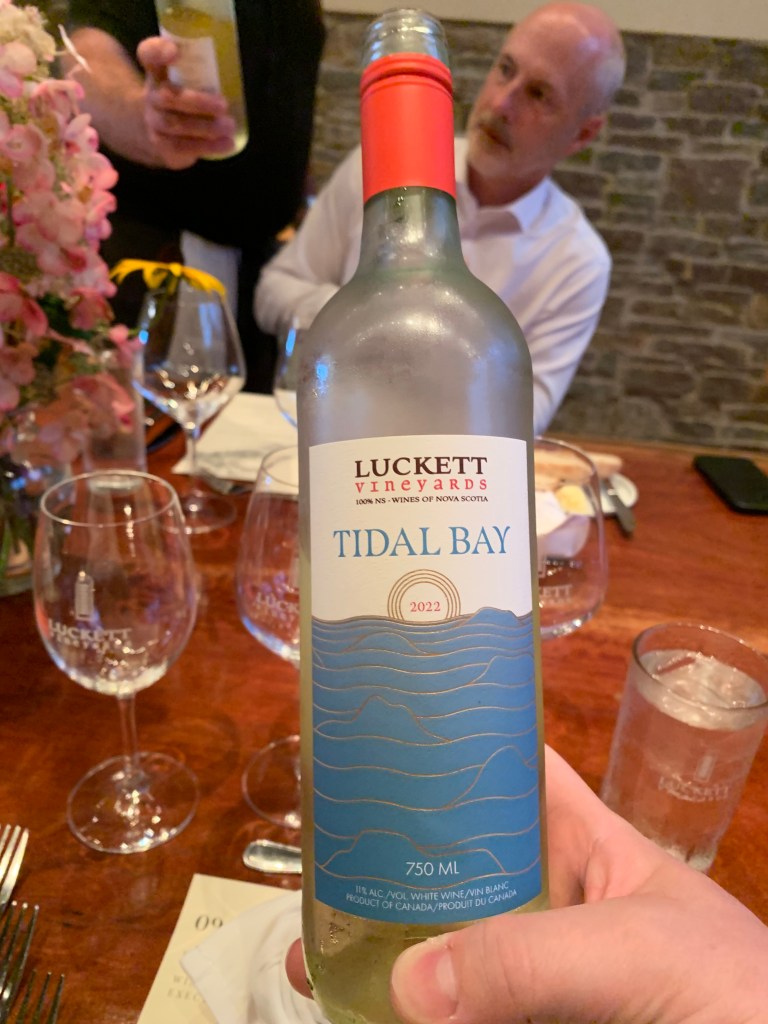
Examples of very good Tidal Bay are produced by Domaine de Grand Pré, Luckett Vineyards, Blomidon Estate Winery, Lightfoot & Wolfville and Benjamin Bridge.
According to the standards, Tidal Bay wines must be made from two or more grape varieties out of more than 20 eligible ones. All of the grapes must be 100% Nova Scotia-grown. The majority (51% or more) of the grapes have to be L’Acadie Blanc, Seyval Blanc, Vidal and/or Geisenheim 318. Another 11 optional, more aromatic varieties such as Riesling, Pinot Gris, Ortega and Frontenac Gris and Blanc can make up the remaining 49% and thirdly, a group of even more aromatic group of grapes are permitted, but they can’t make up more than 15% of the blend. Part of the strict standards is a mandatory annual approval by an independent blind tasting panel.
Wineries are free to use a combination of the approved grape varieties, but wines must demonstrate the distinctive taste profile that reflects the classic Nova Scotian style: lively fresh green fruit, dynamic acidity, and characteristic minerality. Tidal Bay wines must also be relatively low in alcohol and no more than 11%.
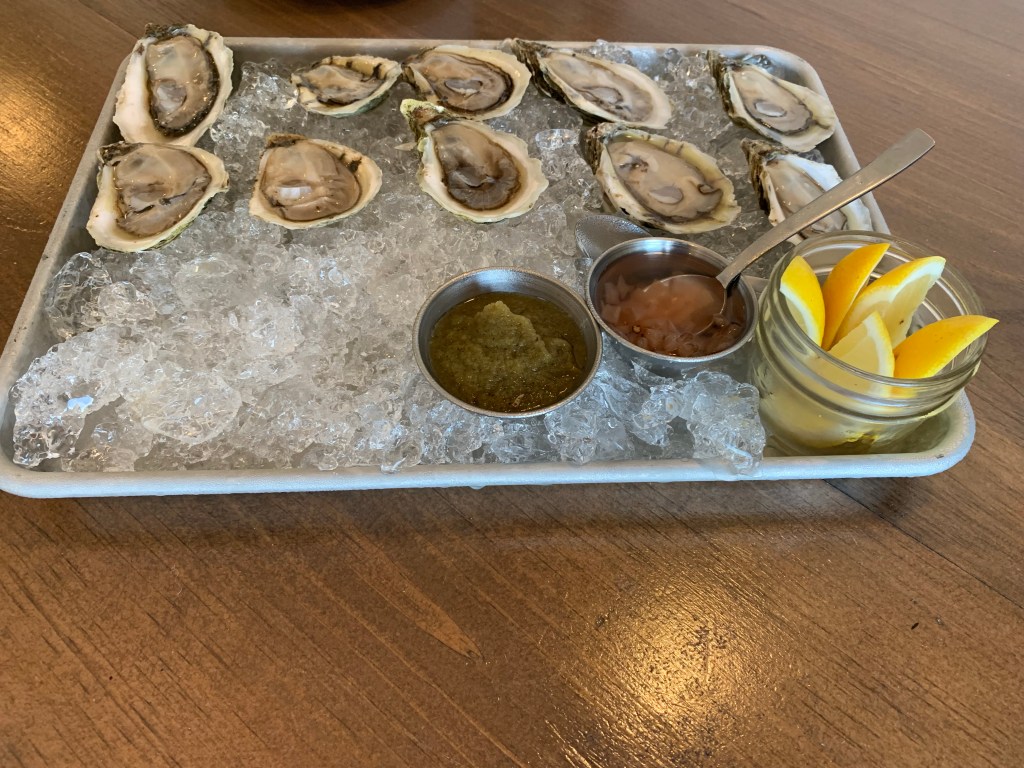
So, if you would try to define Nova Scotia and Nova Scotian wine in one word – or rather two –Tidal Bay wouldn’t be way off. So often has it been described as Nova Scotia in a glass. Cool and crisp, lively and aromatic and an absolutely perfect pairing for the acclaimed, local seafood or simply for socializing with friends.

What grows together does indeed go together!
And, something tells you, they got it right, as Wine Growers Nova Scotia report, that domestic sales of Tidal Bay rose by 27% YoY in 2020, 41% in 2021 and a massive 60% in 2022. To many producers, Tidal Bay has become their bread & butter, so to say, and for Tidal Bay to make up around 50% of the annual production is quite normal.
This obviously results in a need for more grapes. A government funded planting program of 2016-2019 should help sort out this issue.
For importers looking for new, exciting regions and styles to explore, Nova Scotia and Tidal Bay are quite interesting and, due to their smaller sized production, Nova Scotia wineries are only beginning to look for trade partners abroad.
Another Nova Scotian claim-to-fame could and maybe should be the sparkling wines of the province, which I will let you in on in my next article on Nova Scotia.
 LehmannLarsen.com
One thought on “Cool climate Canada – look for Nova Scotia”