Imagine sitting on a taverna in Greece on a hot summer’s day. You enjoy a lovely platter of meze whilst drinking Retsina. Isn’t life just wonderful!
Fast forward to your everyday life. You go to your wine shop and is recommended a bottle of… Retsina. “Oh, no! Not Retsina!”
You know, it doesn’t have to be like that! In my opinion, Greek wine and not least the amazing, versatile, food friendly wine, that the Retsina is, is worthy of receiving much more love from wine drinkers.
Based on history, Greece and her wines would be considered an A student in present days wine and Greek wine deserves to be much more well known, than is the situation today.
Thousands of years back, the ancient Greeks were at the front of winemaking and they brought their grape varieties, their culture and their knowledge to numerous settlements across the Mediterranean region. Winemaking regions were established by Greeks in both Italy, France and Spain, areas which remain important to this very day.
Admittedly, a lot went wrong for Greece and Greek wine since then, but better days seem to await Greek wine. Well, to be quite honest, those better days are already here and they have been for some time.
The quality was arguably never higher than today and Greek wines are indeed popping up everywhere now. As recent inclusions to importers’ assortments, they are present in wine menus and the wine lists in some of the world’s best restaurants and Greek wine is featured in the wine magazines.
Rightfully so, Greek wines have been hyped for quite a while around the world and also in Denmark, open-minded, quality concerned wine drinkers are slowly starting to learn to appreciate Assyrtiko, Xinomavro and Malagousia, largely due to the passionate efforts by e.g. Maria Warming Brink Tsalapatis of Oinofilia, relentlessly advocating the beauty of Greek wines.
The aim of Oinofilia is to revive Greek traditions through the wines, which Maria imports to the Danish and Swedish markets. Smaller producers are sought out, who are foremost working both with indigenous grapes and styles, whose farming is predominantly organically or biodynamically, and whose wines are made with the least possible human intervention.
And that includes one style of wine, that has not at all been getting enough love from end consumers: Retsina!
Key to that is, that way too often, people reach for Retsina at the bottom shelf in the supermarket, and you know what? Quality is hardly ever found there!
But what IS Retsina?
Retsina, or “retinitis oenos” as it was called back in the earliest days, remains the best known traditional Greek wine and the history of Retsina dates back at least 3,500 years and Konstantinos Lazarakis MW explains in The Wines of Greece (2005) about Retsina being created in Central Greece followed by the production spreading to areas such as Macedonia up north and the Aegean Islands.
Retsina is produced by adding the natural resin extracted from pine trees (Aleppo pine is said to produce superior resin) during the fermentation of white predominantly produced from Savatiano and to a lesser degree Roditis (Well, and from other varieties, too…). Much more seldomly, Retsina is made from rosé as well. Once the resin aroma is passed onto the wine, the resin is removed prior to bottling.
Why would the ancient Greeks use pine resin in vinification in the first place?
The Greeks have favoured Retsina since the earliest days of ancient winemaking, when they used pine resin to line and seal the terracotta amphoras, in which the wine was vinified and stored in those days, as the rather porous amphoras allowed the oxygen to easily access the wine. The usage of resin makes perfect sense, given the proximity of the vineyards of Central Greece to the pine forest, which produces resin. Resin was used both as a preservative but also as an additive with the purpose of improving inferior wines and even after wooden barrels replaced amphoras as the preferred storage vessels, the Greeks retained their taste for Retsina as the use of resin provided the wine a particular aroma and taste, that proved to be very much to the liking of the ancient Greeks.
For these reasons, the tradition of frequently overly resiny wine was passed on through generations.
Back 100+ years ago, at the beginning at the 20th century or so, Greece was still very much an agricultural country. It was quite the norm, that farmers, their households and staffs would drink Retsina made from a base of the local white wine and you might even see taverns and families tapping the local pines for their own supply of fresh resin. People had come to appreciate the resin flavours and the addition of resin was a way to improve their other ways utterly bland every-day wine. Such was the importance of Retsina, and such was the quality those days…
Such were the wines, that were served to the tourists, which began travelling in huge numbers to Athens back in the 1960s. As wine-drinkers palates got more refined, the overtly and – frankly speaking – not very good retsinas of those days saw a massive drop in popularity and Central Greece was more or less forgotten about for decades to come.
Fast forward to 2023 and my introductory paragraphs.
To this day, most of us, who have been travelling to Greece or even eaten at a Greek restaurant at home may have received well-meant advice from wine-loving friends: Don’t drink the Retsina(!) – and on the face of it, the warning makes sense, since the flavour of Retsina was often being compared to those of turpentine, even by those who like Retsina. Such was the flavour back in the day, when the understanding of resin and wine was at a much lower level than today.
Admittedly, lots of inexpensive, modern Retsinas are indeed made with poor, thin wine, where the generous addition of resin then masks these absolutely boring wines with its sharp, bracing pungency. And actually, fact is that high volume Retsina for the mass-market, sold in discounters in clear 500-half litre bottles with crown caps, is quite often the cheapest of all wines available – even in Greece, and it is regularly mixed with soft drinks and consumed (presumably for the buzz!) by those on student budgets.
That is the Retsina that people rightfully shy away from.
New wave of Retsina
Today, Central Greece has woken up from her beauty sleep and the most well-known areas for the production of Retsina remain Attica (most notably Mesogia), Viotia and Evia, all in Central Greece, but beautiful Retsina continue to be produced in such different areas as Achaia in the western Peloponnes and Macedonia.
Amongst quality-focused producers, Retsina has really been undergoing a transformation and these producers are showing to the world, that if made thoughtfully and carefully, from meticulously and conscientiously grown grapes, Retsina can be an absolutely delicious gastronomic wine.
Wine drinkers of the 21st century are not, to be polite, quite as big fans of heavily resiny flavours in their wine, as opposed to what the average Greek wine drinker of let’s say the early 1900’s might have preferred to drink and to gain way in export markets, producers simply had to address the issue of how much resin to add and since resin had been used to improve wine, they had to improve the overall quality of their wine to make a Retsina, that Greece could rightfully be proud of and one which could win over winelovers worldwide.
Alas, the real game changer was the improved understanding of resin and a more sophisticated use of it in the wine. A few centuries ago, resin would account for as much as 7,5% of the final wine, and even those 100+ years (early 20th century), that I referred to earlier on, a resin content of around 5% would be the norm, whereas during 1960 it dropped to roughly 2%.
Today, with Retsina being a protected name, having a legal definition, the amounts of resin are restricted to 0,15-1% only.
As touched upon earlier, this is very much to the benefit of Retsina itself and to the palates of modern day winelovers.
Indeed, modern days premium quality Retsina should display the characteristic balsamic aroma of pine, but the wine should by no means be dominated by pine aromas, rather should the pine be in a beautiful marriage with traditional grape aromas. The resiny sense of bitterness should leave a refreshing aftertaste – and this exact trait makes Retsina an ideal companion of the flavourful dishes of traditional Greek cuisine as well as many other intensely flavoured cuisines.
Quality producers, such as Tetramythos, Aoton, Kechris, Georgas Family to name but a few, are leading a peloton, en route to turning Retsina into a cultural tradition. And one, which modern Greeks should rightfully be proud of!
Now, on to tasting some wine:
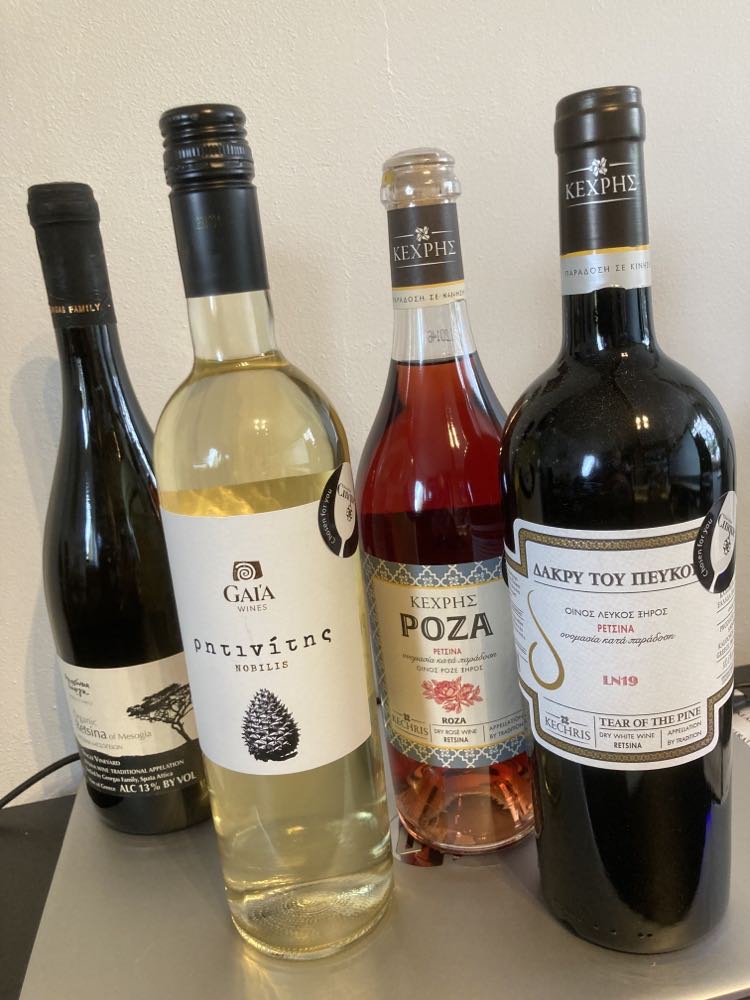
Savatiano is the source of larger quantities of Retsina than any other grape variety.
It does make sense, as this historical white grape variety remains among the most widely planted varieties in Greece even today. Savatiano has been criticized for producing quite basic wines, but it is perfectly capable of producing beautiful wines.
Fact is, that despite its lengthy history, Savatiano remains little explored, probably largely due to its rather lackluster performance until recently. Fortunately, its new and more modern profile is winning over more and more of even the most demanding of wine lovers with its distinct aromas of yellow fruit and freshly cut grasses and a round, well-balanced presence. This hasn’t come neither for free nor overnight. Lots of new ways in both vineyard and cellar to ensure the right levels of acid, cold-soaking and low fermentation temperatures and they selected specific clones from different terroirs.
I was fortunate to experience the results of these development at a seminar on Savatiano, conducted by Konstantinos Lazarakis MW some years ago and he had a really good case in displaying the virtues of the grape as a wonderful, food friendly variety – and as I mentioned earlier on, it does remain the most important grape variety for the production of Retsina.
Whether the basis of Retsina or Savatiano in its own right, the variety is a wonderful companion to various meals and dishes as a genuine and successful “meal wine.”
Georgas Family Black Label
In Spata, east of Athens and in very much the center of Retsina and Savatiano, Mesogia, the Georgas family can account for more than 400 years of experience as grape growers and producers. The street, where the family lives, even carries the name of the family to this day.
Georgas have 4.5 ha under vine and work biodynamically and with very low yields (21 hl/ha). Black Label Retsina is made without the addition of any sulphur and without filtering and the juice is allowed roughly a week’s maceration with the skin to add a bit of colour and texture to the wine.
Georgas Family Black Label is a natural wine, but it is a uniquely Greek natural wine!
And Dimitris Georgas never even had any ambition to become a wine producer! Instead, he obtained multiple degrees on e.g. oceanology and geology and only took on winegrowing and winemaking upon the passing of his father. In 1998 he switched to organic wine growing and by 2000 he went biodynamic. Today, he is considered one of the fathers of Greek natural wine alongside Tatsis Winery in Goumenissa.
Retsina Black Label represents a pure expression of the most ancient Greek winemaking tradition: A natural Savatiano with no sulfites or any additives and from biodynamic grapes. Wild fermented in stainless steel (OK, updated with a slightly modern twist 😉) with 9 days of skin contact, co-fermentation with fresh local pine resin, no intervention and as I stated, no addition of sulphites.
The vines were planted in 1983, grapes were harvested manually and de-stemmed, before being left to macerate.
The wine is packed with ripe and bruised apple – even a touch of apple cider – and pear, ripe and warm lemon and a noticeable pine aroma. I find the wine quite mineral with an oily texture. Ripe apple, pear and underripe pineapple on the palate with resin coming more through here. The wine is un-fined, it is also vegan-friendly.
What sets wines such as this apart from mass-market retsinas is the sheer quality of the wine itself. Many of even the better mass-produced retsinas, the resinous taste is pungent and pure, and often dominates the wine, very often a thin Savatiano.
“The unfortunate fact is that retsinas do not age well,” some say, and they would go on like “Retsinas should be consumed within the year of their production. Not being allowed to print their vintage doesn’t really help.” I don’t disagree, that the freshness of the wine is a strength of Retsina, but I have had success, leaving great Restina in my cellar for extended time.
Roditis is the most planted white grape variety in Greece, and being so incredibly widespread, it is the base for numerous less than excellent everyday white wines, for which reason, Roditis is often characterized as “humble”. Fact, however, is that Roditis is neither a white variety, since its berries’ skin colour veers to the reddish, nor is it “humble”. In fact, given the right conditions, it can yield both excellent and highly disinct wines. Given the fact that its wines are most often modestly priced, Roditis is a strong candidate for the best “value for money” variety of all of Greece.
Cultivated across Epirus, Roditis has handed us the wines from the large PDO Patras, and it plays a key role in the PDO Anchilaos and a minor role in PDO Slopes of Meliton whites, and it is part of countless PGI blends. I agree, some maybe watery and flabby, but nevertheless, limiting yields, selective vineyard sites, carefully vinification and short lees contact are all key elements in Roditis’ transformation into a true Prince Charming!
Contemporary Roditis should possess clear, lemony and/or mineral aromas with refreshing acidity, alas “European” traits.
Despite being so widely grown, Roditis remains one of the least explored Greek varieties and at the same time the numerous wine lovers who have enjoyed a bottle of this variety either as an aperitif or a flawless companion of appetizers and main dishes will not only come to broaden their wine horizons but will also be making a “clever” buy when opting for Roditis.
Gaia Ritinitis Nobilis Retsina
For this wine Gaia gets their grapes from vineyards of 40 years old vines from Koutsi in Nemea, at 450-550 meters of altitude on slopes of 15% gradient and vineyards pruned to dramatically restrict yields.
Since Ritinitis Nobilis from Gaia was first launched back in 1998, Gaia has been trying to redefine Retsina as a much stronger wine – more like a brand or a way of life. A custom. And I firmly believe, that Retsina deserves it.
The origin of Ritinitis Nobilis, however, goes back to the days before Gaia, when Yiannis Paraskevopoulos was still working at Boutari. Words have it, that Yiannis Boutaris made a seemingly simple remark, which stayed with Mr. Paraskevopoulos: “Retsina can be a wine of quality.” It also challenged him, to determine if this statement was at all true – and for him to see if he himself could deliver on it.
Remember, that this was at a time, when quality Retsina hardly even existed. More often, if anything, Retsina would be a source of shame.
Retsina was indeed Greece’s national wine, and as such it needed protection, but you can neither protect nor promote something that isn’t good. So, Mr. Paraskevopoulos had to make a very good one. And this is exactly, what he went on to produce!
The wine is pale lemon and quite aromatic with aromas of pine trees and resin, lemon or even lemon curd, green apple and ripe pear, blossom and is quite flinty.
The acid level is refreshingly high and on the palate the wine displays lemon zest and fresh lemon peel, slightly unripe pineapple, Granny Smith apple, resin and flint plus having a grapefruit like bitterness to it, that makes it very food friendly.
This is a lighter bodied style of wine, which ends on a medium, acid driven, mineral and resiny finish.
As I touched upon earlier, mass-market Retsina would generally be made with Savatiano and at worst, when farmed for high yields rather than good quality, it did indeed require industrial doses of resin for some sense of identity.
Mr. Paraskevopoulos opted for Roditis from relatively high altitudes at some 800-1,000 meters above sea level and he paid close attention to the quality of the resin, making sure it was especially fresh.
The resulting wine was refreshing and invigorating, and with its bright pungency it seems tailored for Greek cooking in all its garlicky, herbal nature. Even though Retsina is a white wine (and occasionally a rosé), it goes beautifully with roasted lamb, as its punchy flavours refuse to succumb under to the savoury meat. Retsina can actually be a wonderful partner for spicy Indian food as well.
Gaia might be one prominent producer of new wave of Retsina, but he is far from alone. Manolis Garalis, on the island of Lemnos, makes lively and refreshing, aromatic and highly personal Retsinas from organically grown Muscat of Alexandria grapes (some Limnio is included in his Rosé-Orange Retsina) from stony, volcanic soils. Why Muscat of Alexandria?
“It’s the only white grape they have on the island!” Garalis’ Retsinas are imported to Denmark by Oinofilia.
Back to Mesogia to taste a pair of stunning Retsinas from Aoton Winery. Mesogia is indeed the home of Savatiano, which was grown in the area almost 4,000 years ago.
Today, Aoton organically cultivate 6 ha. planted with Savatiano and Roditis for the whites and Mandilaria and Cabernet Sauvignon for black grapes.
Aoton Retsina of Mesogia
This is a highly expressive wine from a blend of 75% Savatiano and 25% Roditis from two vineyards (1,65 ha in total) planted in the early to mid-1990s at a rather low density of 3,330 vines per hectare, yielding only 4,600 kg/ha of grapes. So, one expects a good deal of concentration, right!?
And there is plenty! The nose displays pineapple and resin, roasted hazelnuts and almonds, Danish pastry, peach, ripe lemon and candied lemon peel. The 10 months spent on the fine lees with regular batonnage really shows!
Before that, grapes were harvested at night for better preservation of the freshness of the wine and went through approx. 10 days maceration before undergoing wild fermentation. During the fermentation, freshly harvested grapes were added to the fermentation every 24 hours and 0,5 gram/litre of Aleppo pine resin was added to the fermenting most.
To me, this seems an obvious choice with your fish and seafood, or should you cook something just a bit spicy, Aoton Retsina of Mesogia will stand up to the challenge.
Aoton Lola Retsina
This is a beautiful interpretation of rosé Retsina – truly delicious!
Crafted from 70% Mandilaria, 15% Savatiano and 15% Cabernet Sauvignon from 1,7 ha of vineyard from different locations within the Peania sub-region of Mesogia. Harvested at night, just like the former Retsina.
8 months of lees contact are really showing and pairs beautifully with ripe strawberry and cherry, blood orange, processed rhubarb, pine and hazelnuts. I really love the acidity in this wine as well as that slight tannic feel.
Only 0,4 gram/litre of resin was added.
Much further north, another beautiful example of a richer, highly complex style of Restina is produced by Kechris Winery in Thessaloniki:
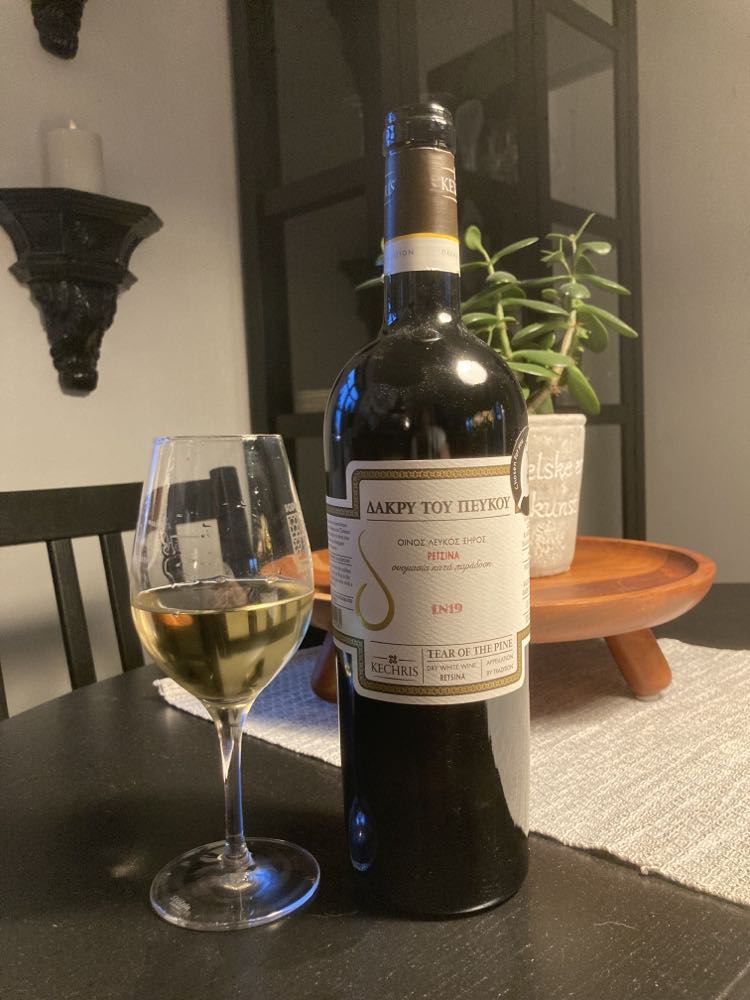
Tear of the Pine is actually Dijon-trained Stelios Kechris’ attempt to find out, just how much of a top tier white Retsina can be.
And over the past two decades, Tear of the Pine has firmly established itself as a remarkable Retsina with real aging potential.
At Kechris, grapes are harvested by hand in small 20 kilo crates to ensure healthy grapes. Some batches undergo a pre-fermentation and fermentation is carried out in either stainless steel tanks or new oak barrels, according to the desired style of Retsina.
Some wine, such as Tear of the Pine, is left to age for 6-24 months in 225-litre oak barrels of French and American origin, both new and old and with different levels of toast to obtain a richer style with a good deal of complexity in the finished wines. Other wines are bottles soon after the fermentation.
Tear of the Pine is 100% Assyrtiko, which is much better known in Santorini. But fact is, that Assyrtiko is no stranger to northern Greece and for this wine, grapes come from Goumenissa in Kilkis in the region of Macedonia. Fermentation takes place in new oak of different origin and is followed by 6 months on the fine lees.
The wine displays intense citrus aroma like lemon and lemon curd together with pine (resin), pineapple, Golden Delicious apple, ripe pear and Nashi pear. The wine shows both leesy and dairy characteristics as well, such as peach melba, pastry, roasted almond and a buttery texture. Vanilla from the barrel aging blends in, too, as does ginger and a touch of rosemary.
This is a full-bodied with very long finish indeed. Lovely acidity and great concentration of fruit, which is in beautiful harmony with the intense mineral character. The resin is more noticeable here than on the nose.
We are dealing with a definite food’s wine here, and one for intensely flavoured food typical of the Mediterranean, such as lobster, seasoned seafood, fat fish, grilled veggies etc.
Goumenissa, though, is much better known for being one of the four PDOs for the great Xinomavro grape and the beautiful, well-structured red wines produced from it.
Very good Retsina is, however, is made from this amazing grape, as well.
Kechris Roza is a pale garnet wine from Xinomavro from Filyria within Goumenissa. Grapes which – despite being harvested already in early September – show great ripeness. Short-period of maceration, alcoholic fermentation in oak and 5 months on the fine lees have made Roza displaying developed aromas and flavours of overripe strawberry and raspberry, pineapple and resin. Slightly nutty with hazelnuts and almonds and a gentle touch of smoke.
There is a lovely acidity here as well as smooth tannins (Xinomavro is quite a tannic variety), which adds to the body of the. I see this wine pairing very well with grilled mushrooms, various dishes with lamb (think Greek or Northern African cuisine) and grilled aubergines.
Our final stop at this round trip to brilliant producers of Retsina is at Ana Diakopto in the western part of Peloponnese, which, high up in the Greek Alps, is where oenologist Panayiotis Papagiannopoulos works his magic at Tetramythos Wines.
Panayiotis is known for being one of the most innovative wine producers in Greece. A man, who has saved local grapes from extinction and researched how to take the use the amphora in the past an put it into a present-day context, as seen in his Retsina Amforɛ Natur.
All of the grapes for this wine come from Tetramythos’ own vineyards at 800 meters of altitude in the windswept mountains near his winery in Ano Diakopto, an area full of vineyards, steep hillsides, deep forests, rivers and stalactite caves – but also known for the largest skiing area in all of Greece.
This amphora-fermented Retsina is a modern classic. Both traditional and pioneering. Organic, natural, elegant, delicate and juicy are other superlatives, that come to mind.
Made from Roditis grapes from 20-25 years old, north facing (hence being less exposed of the most extreme summer sun!) bush-vines, grown in limestone-rich soil at an altitude of 850 meters. The resin for this wine is harvested from the winery’s own pine trees – pretty much at the edge of the vineyards – and the wine is spontaneously fermented in 2-300 old re-used Cretan amphoras. This is a natural wine with no added sulphites and it simply is less resonated, more Roditis.
The resin is present both on the nose and palate, but this wine is much more about the Roditis grape. The resin is very well integrated with notes of citrus, ripe gooseberry and chamomile – and even with a slight pastry note to it. It has a whiff of salt and minerality – this is an all-around thirst quencher and a very drinkable Retsina indeed with nice longevity in the mouth.
This youthful wine pairs very well with grilled fish and spicy foods, but it actually goes well with anything from sushi to kimchi and classic Greek dishes. To me, this is absolute a must-taste wine!
Summer is still here for a long time, so go out and enjoy some lovely Retsina – in Greece or at home.
Because, it is time to give Retsina some much deserved love!
 LehmannLarsen.com

